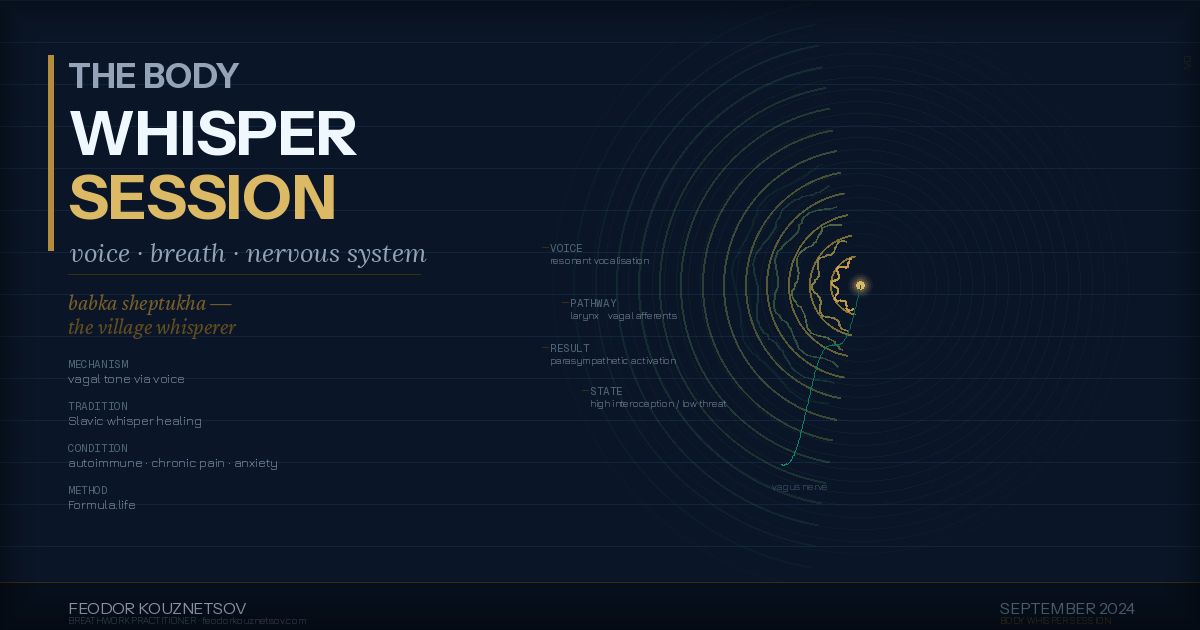
The Body Whisper Session — Where It Came From and How It Works
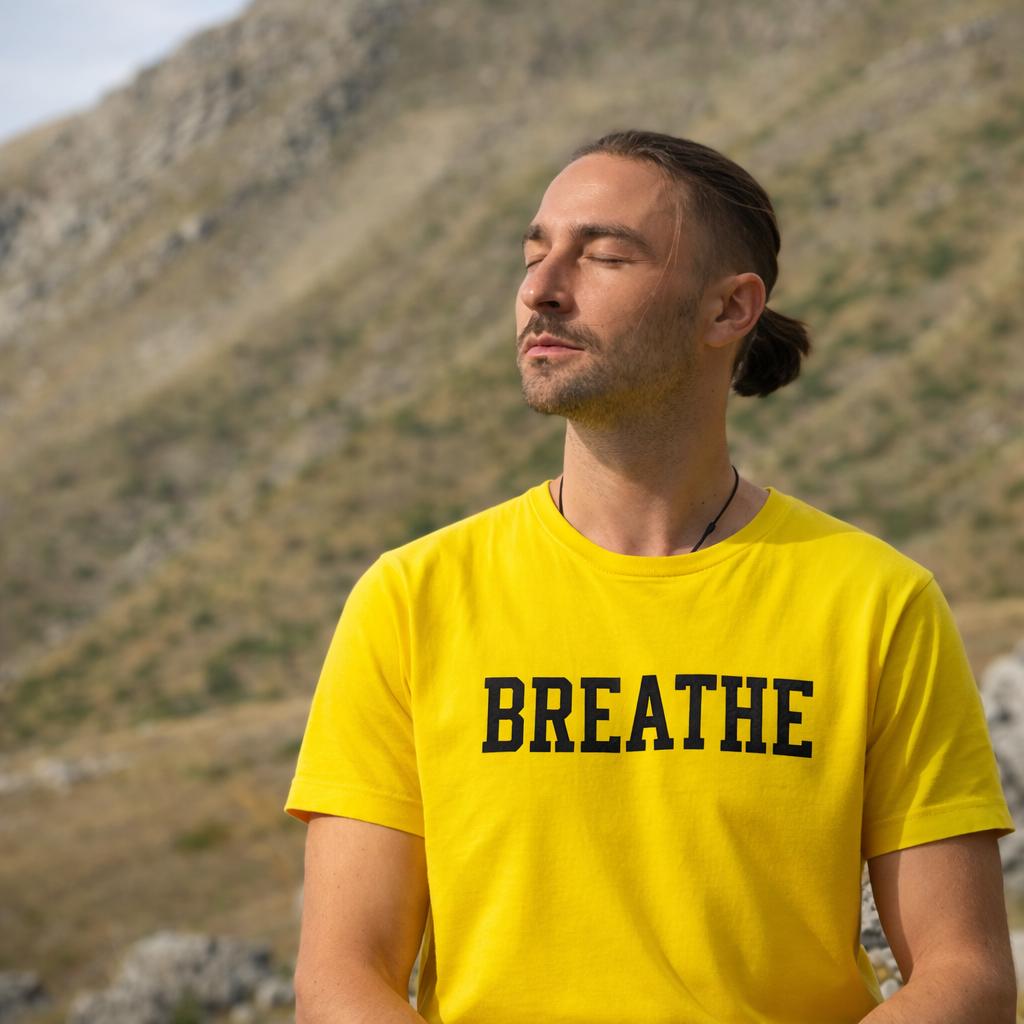
Why I Started Looking for Something That Worked
By 2013, I had been living with Ankylosing Spondylitis for several years and had reached a point of genuine frustration with what conventional approaches were offering me. Not because the medicine was wrong, but because I could see that the condition was responding to things that had nothing to do with medication — to how I breathed, to the state of my nervous system, to levels of stress and activation that I was beginning to understand I could actually influence.
I started practising daily. Every night before sleep, during any quiet window in the day. Breathwork first, then extended periods of quiet in which I began to notice something I had not noticed before: brief moments where the internal noise — the constant stream of thoughts, tension, low-level anxiety — stopped. Not through effort. Through a kind of settling.
It took years to develop any real relationship with that stillness. But what I noticed during those pauses was that my body was responsive in a way it was not during ordinary waking activity. The nervous system, when it moves out of chronic activation, becomes accessible in a different way. This is not mystical — it is the difference between a system locked in defensive mode and one that is open to new input.
The Voice as an Instrument
The voice came into the work gradually. I had been training my voice for years through singing — working with specific syllables, developing my musical ear. And I began to notice that certain vocal qualities, certain frequencies and rhythms, had a direct and immediate effect on the state of the people I worked with. Not as suggestion or placebo, but as something physiological. They would feel it before I explained what I was doing.
This has a straightforward scientific basis. The vagus nerve — the primary pathway of the parasympathetic nervous system — runs directly through the larynx, throat, and inner ear. Slow, resonant vocalisation and gentle sound delivered close to the ear activates vagal afferent fibres that signal safety to the brainstem. The body responds by downregulating the threat state. Heart rate variability improves. Muscle tension releases. The nervous system moves toward a receptive rather than defensive mode.
The whisper specifically matters. A whisper requires the listener to become still and attentive without triggering the startle response that louder sound can produce. It communicates proximity and safety simultaneously. In many traditional healing systems — including the babka sheptukha of Slavic folk medicine, the village whisperer who worked with breath and voice directly at the ear — this was understood intuitively long before the neuroscience caught up.
I named the method the Body Whisper Session partly in reference to this tradition, and partly because it accurately describes what happens: voice-based work delivered close to the body, working with the nervous system rather than talking at the mind.
What Happens in a Session
A session combines directed breathing with voice work and body attention. The breathing component shifts the autonomic state — moving the nervous system out of sympathetic dominance and into a parasympathetic mode where the body is more responsive. The voice work operates on the vagal pathways, deepening and sustaining that shift. The body attention — noticing physical sensations, temperature, movement, tension and release — gives the nervous system specific signals to process rather than maintaining its default alert scanning.
People consistently describe a quality of awareness during sessions that is distinct from ordinary relaxation: alert but deeply still, aware of the body in unusual detail, able to observe internal states without being driven by them. This is not a trance in any dramatic sense. It is closer to what happens in advanced breathwork practice — a state of high interoceptive awareness with low sympathetic activation.
What becomes possible in that state is genuine nervous system retraining. Patterns that are reinforced by chronic activation — pain amplification, thought loops, inflammatory cycles — become more available for change when the activation is removed. The work is not about installing new beliefs or programming anything. It is about creating the conditions in which the body's own regulatory capacity can operate without the interference of a locked defensive state.
What I Can and Cannot Do
I want to be direct about this, because I think it matters for anyone considering this work.
I do not heal anyone. A colleague reminded me of this plainly when I was frustrated about a session that had not gone the way I hoped: the healer is always the person undergoing the work. What I provide is a set of conditions and a guided process. What happens within those conditions depends entirely on the person — on their readiness, their capacity to be present, and fundamentally on how much they actually want to change.
In my experience, the people who benefit most are those who are genuinely tired of their current state — not people who are intellectually interested in healing, but people who have reached a point where continuing as they are is simply no longer acceptable. That quality of readiness matters more than any particular diagnosis or history.
The work is particularly relevant for people managing chronic inflammatory and autoimmune conditions, persistent anxiety, OCD and thought loops, and chronic pain — conditions where the nervous system is a central part of the picture and where standard approaches address the presenting symptoms without reaching the underlying regulatory state.
Working With Me
Sessions are conducted online via video call. Before we work together, I ask everyone to complete a short assessment — it gives me the context I need to understand your current state and tailor the session accordingly rather than working generically.
If you want to understand your own baseline first, the assessment is the right place to start. If you are ready to book directly, you can find session details and availability on the sessions page. And if you are not sure whether this work is relevant to your situation, get in touch — I will tell you directly if I think I can help.
Next step
Want to work through your situation personally?
Disclaimer: personal experience & self-regulation practices. Not medical advice.