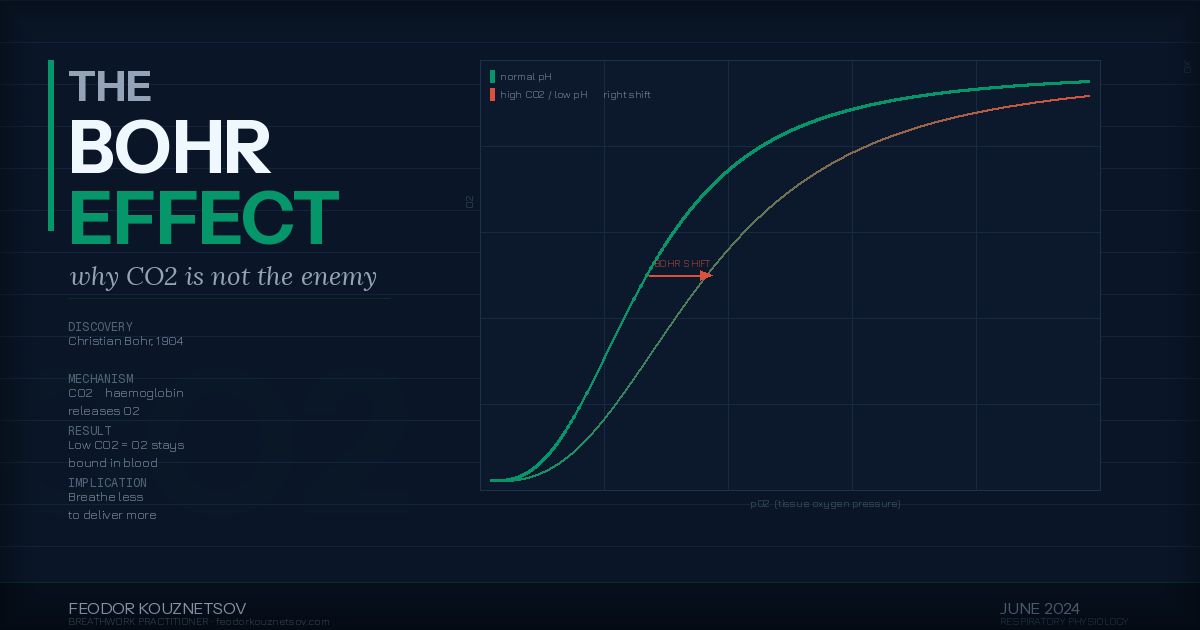
The Bohr Effect — Why Carbon Dioxide Is Not the Enemy

The Assumption Most People Make About Breathing
When people think about improving their breathing, the instinct is almost always to breathe more — deeper, fuller, more frequently. More oxygen in, more carbon dioxide out. It seems logical. Oxygen is what the cells need, and CO2 is just a waste product to be cleared as efficiently as possible.
This assumption is not just incomplete — it is the direct cause of some of the most common breathing problems I work with. Chronic over-breathing, hyperventilation, mouth breathing, chest breathing: all of them are driven, at least in part, by the belief that more breathing equals more oxygen delivery. The Bohr Effect explains exactly why this is wrong.
What the Bohr Effect Actually Says
In 1904, Danish physiologist Christian Bohr published a finding that changed how we understand respiratory physiology. He observed that haemoglobin — the protein in red blood cells that carries oxygen — does not release oxygen at a constant rate. Its willingness to release oxygen depends on the local environment, specifically on the concentration of CO2 and the pH of the surrounding tissue.
The relationship is this: the higher the CO2 concentration in a tissue, the more readily haemoglobin releases its oxygen there. Conversely, when CO2 levels are low — as they are in the blood of someone who chronically over-breathes — haemoglobin holds onto its oxygen more tightly, even as it circulates through tissues that need it.
This is the Bohr Effect. Your red blood cells can be fully loaded with oxygen, your blood oxygen saturation can read 99%, and yet your tissues can be relatively starved of oxygen — simply because the CO2 signal that triggers oxygen release is too weak.
CO2 is not a waste product to be eliminated as fast as possible. It is a functional signal that tells your blood where to deliver oxygen. Without adequate CO2, oxygen delivery becomes inefficient regardless of how much oxygen is in your blood.
Why Chronic Over-Breathing Undermines Oxygen Delivery
Most people breathing incorrectly are not breathing too little. They are breathing too much — and usually through the mouth, which bypasses the nose's role in warming, filtering, and regulating airflow. Chronic over-breathing progressively lowers the baseline CO2 level in the blood, a state called hypocapnia.
In hypocapnia, the Bohr Effect works against you. Haemoglobin becomes less likely to offload oxygen in the tissues because the CO2 signal is chronically suppressed. The tissues, paradoxically, receive less usable oxygen even though the blood is carrying plenty of it. The body compensates by increasing breathing rate further — which makes the problem worse.
This cycle is self-reinforcing. Over time, the chemoreceptors that monitor CO2 recalibrate to a lower set point. Breathing that would feel normal to a well-regulated person begins to feel suffocating. Anything that briefly raises CO2 — exercise, speaking, a moment of emotional stress — triggers an urgent urge to breathe deeply or yawn, not because oxygen is genuinely low but because the nervous system has become oversensitive to CO2 fluctuation.
The Bohr Effect in Chronic Conditions
For people living with chronic inflammatory conditions — including Ankylosing Spondylitis, which I have managed without constant medication since 2015 — this matters considerably. Chronic pain and autoimmune activity keep the nervous system in a sustained stress state, which in turn drives faster, shallower breathing. Faster breathing lowers CO2. Lower CO2 impairs oxygen delivery to tissues already under inflammatory stress.
The Bohr Effect also has direct relevance to:
- COPD and asthma — where breathing pattern manipulation directly affects oxygenation outcomes
- Sleep apnoea — where disrupted breathing chemistry during sleep creates cycles of hypoxia and hypercapnia
- Anxiety and panic — where the CO2 sensitivity dysregulation is often the primary mechanism driving symptoms, not psychological triggers
- Exercise intolerance — where poor CO2 tolerance limits performance well before cardiovascular capacity is actually reached
What This Means in Practice
The practical implication of the Bohr Effect is not that you should try to retain CO2 artificially or breathe in unusual ways. It is simpler than that: breathing less, more slowly, and through the nose is more efficient than breathing more.
Nasal breathing alone imposes enough resistance to slow the breath and maintain healthier CO2 levels. Diaphragmatic breathing reduces the volume of dead space ventilation compared to chest breathing. Extending the exhalation activates the vagal braking response and allows CO2 to accumulate slightly before the next inhalation — which is exactly the condition the Bohr Effect requires for efficient oxygen delivery.
Techniques like Buteyko breathing are built almost entirely on this principle — reducing breathing volume to raise CO2 tolerance, which in turn improves oxygen delivery through the Bohr Effect. The results are measurable: improved resting oxygen saturation in tissues, reduced breathlessness during exercise, and a calmer, less reactive nervous system.
A Simple Self-Check
One of the clearest indicators of your CO2 tolerance is the Control Pause — a Buteyko measurement. After a gentle normal exhale, pinch your nose and hold. Count the seconds until you feel the first definite urge to breathe. Do not push through it — stop at the first distinct signal.
Under 20 seconds typically indicates significant over-breathing and poor CO2 tolerance. 20–40 seconds is moderate. Above 40 seconds suggests good respiratory chemistry. Most people with anxiety, chronic fatigue, or chronic pain score well under 20 on their first attempt.
This is not a breathing exercise — it is a measurement. But it tells you something concrete about where you are starting from.
Where to Go From Here
Understanding the Bohr Effect changed how I think about breathing entirely. It shifted my focus from volume to efficiency — from breathing more to breathing better. That shift, applied consistently over time, is one of the most significant things I have done for my own health.
If you want to explore your own breathing patterns in a guided, real-time format, the breathing practice tool at feodorkouznetsov.com/breathe is a practical starting point. And if you want a fuller picture of where your nervous system and breathing currently stand, take the assessment — it covers breathing, physical state, inflammation, and lifestyle, and gives me what I need to give you a specific next step rather than a generic one.
Next step
Want to work through your situation personally?
Disclaimer: personal experience & self-regulation practices. Not medical advice.