Breathing Happens — But Not Always Well
Breathing Happens — But Not Always Well
I have been practising breathing exercises for many years. And after more than 1,500 hours of conscious breathing practice, I arrived at a simple but important realisation: breathing happens. It is an automatic process — the body knows how to do it. Most people never think about their breathing at all.
But automatic does not mean optimal.
The habit of breathing is shaped by countless factors, particularly in childhood. In my case, I had bronchitis as a child and shifted to mouth breathing because my nose was constantly blocked. That one shift — which felt completely natural at the time — led to years of hyperventilation, structural changes in my teeth, and a chronic background of stress that I did not even recognise as stress until much later. I carried that pattern for over thirty years.
The same thing happens in different ways for many people. You got frightened as a child and developed a tendency to breathe high in the chest. Or you spent years hunched at a desk and your posture collapsed your lung volume. Or you learned, somewhere along the way, to hold your breath under pressure. These patterns become invisible precisely because breathing is automatic — it runs in the background, below the threshold of conscious attention.
This is why bringing awareness to how you breathe matters. Not to control every breath, but to notice what your default pattern actually is.
How the Breathing System Works
The respiratory centre — located in the brainstem — is responsible for the entire breathing process. It consists of two parts: the centre of inspiration and the centre of expiration. These two structures regulate how deeply and how often you breathe, using a dense network of neurons communicating through axons.
The respiratory centre continuously monitors levels of carbon dioxide, oxygen, and blood pH, then adjusts breathing accordingly. Central and peripheral chemoreceptors, along with mechanoreceptors, feed it this information in real time. A breath in, a breath out — and none of it requires your conscious involvement.
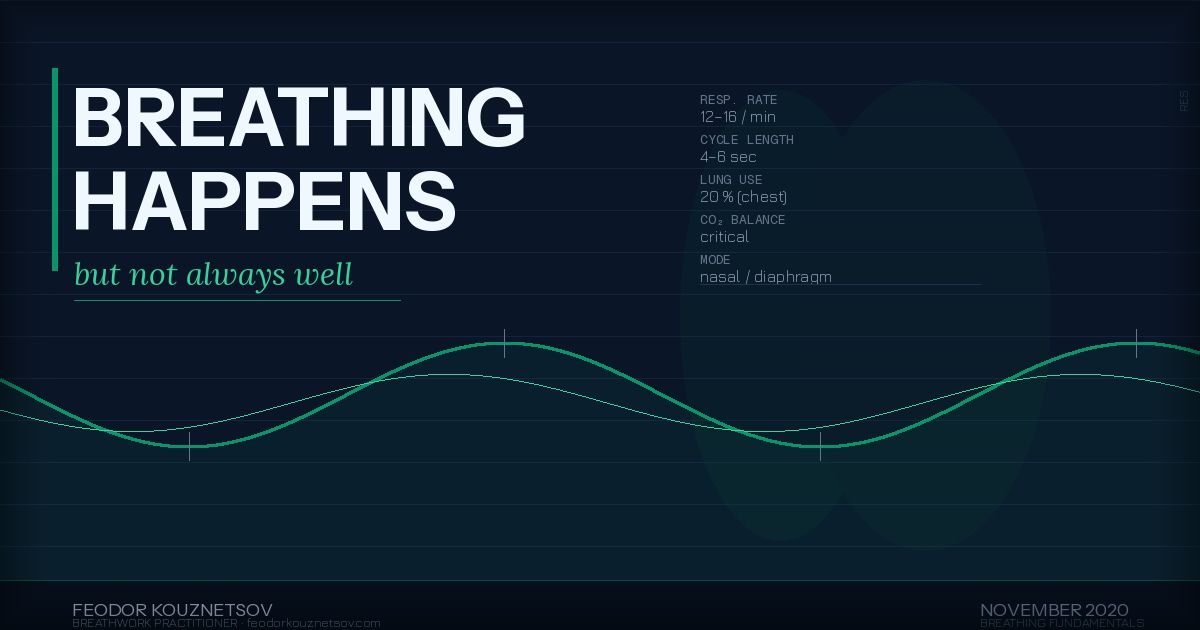
Under typical conditions, breathing follows a regular rhythm: 12 to 16 breath cycles per minute, with each cycle taking roughly 4 to 6 seconds. This is sometimes referred to as eupnoea — normal, unforced breathing.
How Breathing Changes Across Different States
Breathing is not static. It adapts constantly to what you are doing:
- During conversation or eating, the rhythm shifts temporarily — brief breath holds on inhalation or exhalation are common.
- During slow-wave sleep, breathing becomes shallower and slower.
- During REM sleep, it deepens and quickens.
- During exercise, increased oxygen demand drives the rate up — sometimes reaching 40 breaths per minute at high intensity.
These are normal, adaptive changes. The problem is not breathing that adapts to a situation. The problem is breathing that gets stuck in a stress pattern even when no stress is present.
Upper Chest Breathing and Why It Matters
Over time, muscle tension in the back and upper shoulders — combined with poor posture — pushes many people into a pattern of chest or even clavicular breathing. In this pattern, the diaphragm barely engages, and only about 20% of lung volume is actually used.
A simple test: place one hand on your stomach and take a breath. Did your hand move? If your chest rose and your abdomen stayed still, you are breathing from the chest or clavicles — and your body is not being adequately supplied with oxygen, regardless of how many breaths you take.
Hyperventilation and Hypoventilation
Breathing too fast or too deeply — hyperventilation — increases the speed of air intake but does not improve oxygenation of the tissues. It reduces carbon dioxide in the blood (hypocapnia), alkalises the blood, and paradoxically impairs oxygen delivery at the cellular level. The body reacts with dizziness, yawning, visual disturbances, heart discomfort, and in extreme cases, loss of consciousness.
The human body reacts to physical and psychological stress by changing the pattern of breathing. The trouble is that the pattern often outlasts the stress itself.
The opposite — hypoventilation, breathing that is too shallow and slow — leads to hypercapnia: a sharp rise in carbon dioxide and a drop in available oxygen. This also impairs oxidative processes in the tissues.
The goal is neither fast nor slow for its own sake — it is breathing that is calibrated to what your body actually needs in the moment.
The Default: Nasal, Rhythmic, Diaphragmatic
Under normal conditions, the nose is the correct route for breathing. Air inhaled through the nose is warmed, humidified, and filtered before it reaches the lungs. Breathing should be calm, rhythmic, and deep enough to engage the diaphragm.
I see this pattern broken constantly — particularly among runners. Many people who jog are mouth-breathing throughout, which drives chronic overbreathing and keeps the nervous system in a low-grade stress state. Some are mouth-breathing and talking simultaneously, which tells me their CO2 tolerance is disrupted to the point where they can no longer feel the difference.
Health depends, to a significant degree, on how you breathe — not occasionally, but habitually. Strengthening the respiratory muscles and improving lung ventilation only works if the foundational breathing pattern is correct first.
Where to Start
If any of this resonates — if you recognised your own patterns in what I described — the good news is that breathing habits can be changed. I work with people one-on-one through individual sessions, and I have structured courses that address these foundations directly. If you want to start by understanding your own baseline, the breathing assessment is a practical first step.
Next step
Want to work through your situation personally?
Disclaimer: personal experience & self-regulation practices. Not medical advice.