Chronobiology and Breathwork — How Circadian Rhythms Affect Nervous System Regulation
Why Circadian Disruption Matters for Nervous System Function
Your nervous system does not operate on a flat timeline. It runs on rhythms — daily oscillations in hormone production, autonomic tone, immune function, and metabolic activity that repeat approximately every 24 hours. These rhythms are governed by the circadian clock, a network of cellular oscillators that synchronize physiological processes to the light-dark cycle.
When circadian rhythms are disrupted — whether through shift work, irregular sleep, artificial light exposure, or chronic stress — the consequences extend far beyond feeling tired. Circadian misalignment drives autonomic dysregulation, reduces heart rate variability, increases systemic inflammation, and worsens symptoms of chronic conditions from anxiety to autoimmune disease.
This post covers how circadian rhythms affect nervous system regulation, how breathwork interacts with these rhythms, and how to time breathwork practice to support rather than undermine circadian function.
The Circadian Clock and Autonomic Function
The master circadian clock is located in the suprachiasmatic nucleus (SCN) of the hypothalamus. It receives light input from the retina and coordinates peripheral clocks throughout the body — in the liver, gut, heart, lungs, and immune cells. These peripheral clocks regulate everything from cortisol secretion to blood pressure to inflammatory cytokine production.
The autonomic nervous system follows a predictable circadian pattern in healthy individuals:
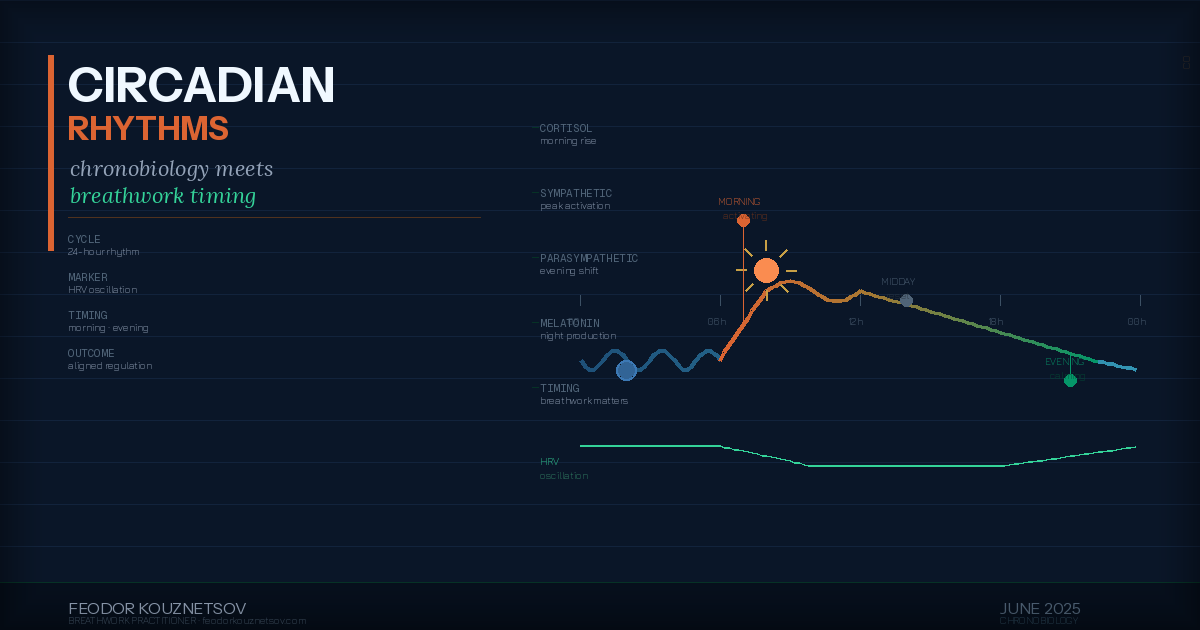
- Morning: Cortisol rises sharply within 30-60 minutes of waking (cortisol awakening response), sympathetic tone increases, blood pressure rises, and the body prepares for activity
- Midday: Peak alertness, highest core body temperature, optimal physical and cognitive performance
- Evening: Cortisol declines, sympathetic tone decreases, parasympathetic activity increases, melatonin production begins as light fades
- Night: Parasympathetic dominance, lowest heart rate, deepest sleep cycles, immune activation and tissue repair
When this rhythm is intact, heart rate variability (HRV) shows a clear diurnal pattern — lowest in the morning when sympathetic tone is high, highest during sleep when parasympathetic tone dominates. This oscillation is healthy. It indicates that the autonomic nervous system is responding appropriately to environmental and internal cues.
What Happens When Circadian Rhythms Are Disrupted
Circadian misalignment occurs when internal biological time is out of sync with external time. This happens with:
- Shift work or irregular work schedules
- Late-night artificial light exposure (especially blue light from screens)
- Inconsistent sleep-wake times (social jetlag)
- Eating late at night when the digestive system expects rest
- Chronic stress that overrides normal cortisol rhythms
The consequences are extensive and measurable:
Reduced HRV and Autonomic Dysregulation
Circadian disruption flattens the normal HRV oscillation. Instead of the healthy rise and fall across the day, HRV remains chronically low — a marker of sympathetic dominance and reduced parasympathetic activity. This is not just a statistical finding. It correlates directly with increased cardiovascular risk, impaired glucose regulation, and worsened mental health outcomes.
Elevated Inflammation
Inflammatory cytokines (IL-6, TNF-alpha) follow circadian rhythms. In healthy individuals, pro-inflammatory markers are suppressed at night to allow tissue repair. When circadian rhythms are disrupted, this suppression fails, and baseline inflammation increases. For people managing autoimmune or inflammatory conditions, circadian misalignment can be the difference between controlled disease and persistent flare activity.
Dysregulated Cortisol
The cortisol awakening response becomes blunted or absent, and cortisol may remain elevated into the evening when it should be declining. This creates a state of chronic low-grade stress that perpetuates sympathetic dominance and undermines the ability to enter deep parasympathetic states during sleep.
Sleep Architecture Damage
Circadian misalignment reduces slow-wave sleep and REM sleep, the stages where nervous system recovery and memory consolidation occur. Even if total sleep duration is adequate, sleep quality suffers, and the restorative functions of sleep are impaired.
How Breathwork Interacts With Circadian Rhythms
Breathwork is not circadian-neutral. The timing, intensity, and type of breathwork you practice can either support or disrupt circadian function.
Morning: Sympathetic Activation Is Appropriate
In the morning, your nervous system is naturally shifting toward sympathetic activation. Cortisol is rising, core body temperature is increasing, and the body is preparing for activity. Breathwork that amplifies sympathetic tone — rapid breathing, breath holds, forceful exhalations — aligns with this natural rhythm.
Techniques like Kapalabhati (skull-shining breath) or Wim Hof-style hyperventilation followed by breath retention are most appropriate in the morning. They produce adrenaline and noradrenaline release, increase alertness, and reinforce the natural morning surge in arousal. Done at this time, they do not disrupt circadian function — they amplify it.
Evening: Parasympathetic Activation Is Essential
As evening approaches, the nervous system should be shifting toward parasympathetic dominance. Cortisol declines, melatonin production begins, and the body prepares for sleep. Breathwork practiced in the evening should support this transition, not fight it.
Extended exhalation breathing, coherent breathing (5-6 breaths per minute), and slow nasal breathing all activate vagal pathways and reduce sympathetic output. Practiced 1-2 hours before sleep, they facilitate the shift into parasympathetic dominance and improve sleep onset and quality.
Conversely, practicing activating breathwork in the evening — hyperventilation, rapid breathing, intense breath holds — suppresses melatonin production, delays sleep onset, and disrupts the natural circadian decline in arousal. This is one of the ways well-intentioned breathwork can inadvertently worsen sleep and circadian function.
Light Exposure and Breathwork: The Forgotten Connection
The most powerful circadian zeitgeber (time-giver) is light. Morning light exposure within 30-60 minutes of waking synchronizes the SCN and reinforces the natural cortisol awakening response. Evening light exposure — particularly blue light from screens — suppresses melatonin and delays the circadian phase, making it harder to fall asleep and reducing sleep quality.
Breathwork does not override the effects of light, but it can amplify them. Morning breathwork outdoors, with natural light exposure, produces a stronger circadian signal than the same practice done indoors. The combination of light input to the SCN and autonomic activation through breathwork creates a synergistic effect that strengthens circadian rhythms.
Similarly, evening breathwork practiced in dim light or darkness supports melatonin production and circadian alignment. Practicing the same breathwork in bright artificial light undermines the circadian signal and reduces the effectiveness of the practice.
Practical Application: Timing Breathwork for Circadian Support
If you are managing chronic conditions where circadian disruption is a contributing factor — anxiety, autoimmune disease, chronic pain, sleep disorders — timing your breathwork practice correctly is not optional. It is part of the intervention.
Morning (Within 1-2 Hours of Waking)
Goal: Reinforce sympathetic activation and cortisol awakening response
Techniques: Rapid breathing (Kapalabhati, Breath of Fire), breath holds after exhalation, forceful exhalations
Duration: 5-10 minutes
Context: Outdoors or near a window with natural light exposure
Midday (Optional, If Needed)
Goal: Reset autonomic state if stress has accumulated
Techniques: Coherent breathing (5-6 breaths/min), box breathing, physiological sighs
Duration: 3-5 minutes
Context: Brief reset before high-stress inputs (meetings, difficult tasks)
Evening (1-2 Hours Before Sleep)
Goal: Facilitate parasympathetic shift and prepare for sleep
Techniques: Extended exhalation (4:7 or 4:8 breathing), coherent breathing, pursed-lip breathing
Duration: 10-20 minutes
Context: Dim lighting, no screens, consistent timing nightly
Night (If Waking Mid-Sleep)
The Hypoxic vs. Hyperventilation Distinction
It is important to distinguish between hyperventilation practices and hypoxic (breath hold) practices, because they produce different effects and have different timing considerations.
Hyperventilation (rapid breathing): Wim Hof method, Kapalabhati, Breath of Fire — these reduce CO2 rapidly and trigger acute sympathetic activation via adrenaline and noradrenaline release. They are incompatible with evening circadian preparation and should always be reserved for morning practice.
Hypoxic practices (breath holds): These exist on a spectrum from calming to activating, depending on intensity and context.
Avoid in the evening:
- Intense breath holds after hyperventilation (Wim Hof retention phase)
- Maximum-duration breath holds (60+ seconds, especially after exhalation)
- Repeated challenging breath holds where the goal is to push air hunger tolerance
These create acute sympathetic activation even though they are not hyperventilation. The physiological stress of prolonged air hunger triggers the same arousal response that undermines evening parasympathetic shift.
Acceptable in the evening:
- Brief breath holds in box breathing (4-4-4-4 pattern)
- Gentle pauses at the top or bottom of breath (1-3 seconds)
- Breath holds used as part of slow, calming rhythms rather than as a challenge
The key distinction is arousal vs. regulation. If the breath hold creates intense air hunger, activates your stress response, or makes you more alert — it is activating and should be reserved for morning. If it is a gentle pause in a slow rhythm that maintains calm — it does not disrupt evening parasympathetic activation.
Practical test: After the practice, do you feel more alert or more calm? If alert → morning only. If calm → appropriate for evening.
Goal: Return to sleep without activating sympathetic nervous system
Techniques: Very slow nasal breathing, extended exhalation, no breath holds
Duration: Until sleep returns (usually 5-10 minutes)
Context: Stay in bed, darkness, no light exposure
When Circadian Rhythms Are Already Disrupted
If you are dealing with chronic circadian misalignment — shift work, chronic insomnia, long-term stress — breathwork alone will not fix it. But it can support the restoration process when combined with light exposure, consistent sleep-wake timing, and meal timing aligned to circadian function.
The strategy is to use breathwork to amplify the circadian signals you are trying to establish:
- Morning light + activating breathwork → strengthen cortisol awakening response
- Consistent evening routine + calming breathwork → reinforce melatonin production
- Avoid evening activating practices → prevent melatonin suppression
Recovery takes weeks, not days. The circadian clock is slow to shift, and re-entrainment requires consistent input over time. But breathwork timed correctly accelerates the process by providing an additional autonomic signal that reinforces the light-dark cycle.
Measuring the Effect: HRV as a Circadian Marker
If you track HRV, you can see circadian function reflected in your data. Healthy circadian rhythms produce:
- Lower HRV in the morning (appropriate sympathetic activation)
- Rising HRV through the day as parasympathetic tone increases
- Highest HRV during sleep
- Consistent day-to-day patterns
Disrupted circadian rhythms show as flattened HRV curves — no clear diurnal variation, chronically low values, or erratic day-to-day patterns. Restoring circadian function through timed breathwork, light exposure, and sleep consistency will show up as the HRV oscillation returning over weeks.
Working With This
If circadian disruption is contributing to your symptoms — poor sleep, chronic fatigue, anxiety, inflammatory flares — addressing it requires more than just practicing breathwork. It requires practicing breathwork at the right times, combined with light exposure management and sleep-wake consistency.
The assessment includes questions about sleep patterns and daily rhythms, which help me identify whether circadian misalignment is a factor. And in individual sessions, I teach not just breathwork techniques but when to practice them based on your specific schedule and symptoms.
Chronobiology is not a niche concern. It is one of the most fundamental regulators of nervous system function. Ignoring it means fighting your own biology. Working with it means having the circadian rhythm amplify rather than undermine your breathwork practice.
Next step
Want to work through your situation personally?
Disclaimer: personal experience & self-regulation practices. Not medical advice.