Holotropic Breathwork vs Formula.life — When Each Approach Is Appropriate

Two Different Tools for Different Purposes
Holotropic breathwork and Formula.life are both breathing-based practices, but they are built for entirely different applications. Comparing them without understanding this distinction leads to confusion about what each one does and who should be using it.
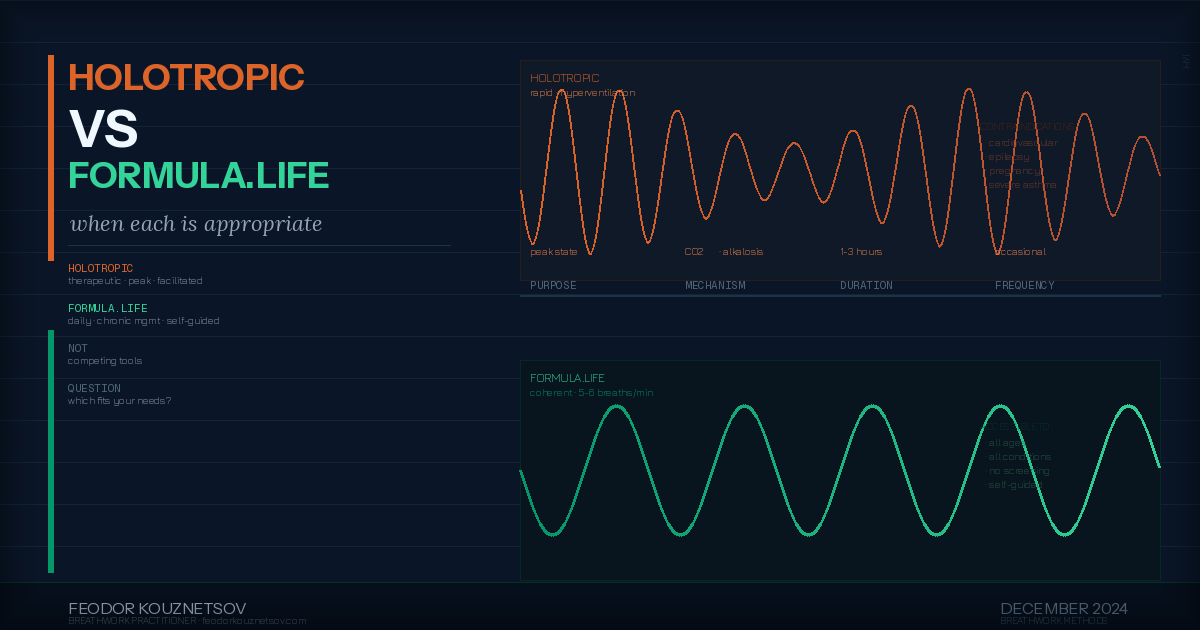
Holotropic breathwork, developed by Stanislav Grof in the 1970s, is a therapeutic intervention designed to access non-ordinary states of consciousness for the purpose of processing trauma, grief, and unresolved emotional material. It involves sustained hyperventilation — rapid, deep breathing for extended periods — which produces measurable physiological changes including cerebral vasoconstriction, alkalosis, and altered brain activity. These states can be therapeutically valuable in the right context with proper facilitation, but they are not appropriate for everyone and not designed for daily use.
Formula.life is a daily breathwork practice designed for nervous system regulation, chronic condition management, and long-term resilience building. It emphasises coherent breathing, CO2 tolerance, and vagal activation rather than hyperventilation. It is built to be used regularly, indefinitely, without medical contraindications.
The question is not which one is "better." The question is which one is appropriate for your situation and goals.
What Holotropic Breathwork Actually Does
Holotropic breathwork uses prolonged hyperventilation to shift brain activity and induce altered states. The mechanism is straightforward: rapid breathing lowers CO2, which constricts cerebral blood vessels and reduces cerebral perfusion. This produces light-headedness, tingling in the extremities, and — in many people — visual or emotional experiences that feel profound or cathartic.
When facilitated properly in a therapeutic context, these states can provide access to material that is otherwise defended against. For people processing specific trauma or stuck emotional patterns, this can be clinically useful. Grof's work was originally developed as an alternative to LSD-assisted psychotherapy, and in that context the comparison makes sense: both are peak experiences designed to catalyse change, not practices for regular maintenance.
The issue is not that holotropic breathwork is inherently dangerous. The issue is that it has a narrow therapeutic window and significant contraindications that are often underemphasised in wellness contexts where it is marketed as a general personal development tool.
The Contraindications That Matter
Holotropic breathwork is contraindicated for anyone with:
- Cardiovascular disease or uncontrolled hypertension
- Epilepsy or seizure disorders
- Severe asthma or other respiratory conditions
- Pregnancy
- Recent surgery or physical injury
- Acute psychosis or unstable psychiatric conditions
- History of aneurysm or stroke
These are not minor exclusions. They represent a significant portion of the population, and particularly the population most likely to be seeking breathwork for health reasons. The cardiovascular strain from prolonged hyperventilation is real, the seizure risk in susceptible individuals is documented, and the potential for emotional destabilisation in people with fragile psychiatric conditions is well-established.
This does not make holotropic breathwork "bad." It makes it a tool with a specific therapeutic indication and a need for proper screening and facilitation. The problem arises when it is offered casually in workshop formats without adequate medical history screening or when people attempt it alone after watching a video.
Where Formula.life Sits
Formula.life was developed as a daily practice for people managing chronic conditions, anxiety, OCD, ADHD, and nervous system dysregulation. It is designed to be safe for long-term use without the physiological strain that hyperventilation produces.
The method combines:
- Coherent breathing — around 5-6 breaths per minute, which maximises heart rate variability and vagal tone
- Buteyko principles — nasal breathing and CO2 tolerance rather than CO2 depletion
- Rhythmic counting and visualisation — to occupy the default mode network and reduce thought loops
- Structured cycles — 49 breaths per cycle, scalable from 1 cycle (10 minutes) to 7 cycles (just over an hour)
The goal is not to induce altered states or access non-ordinary consciousness. The goal is to shift the autonomic baseline, reduce chronic nervous system activation, and build the capacity for sustained calm and focus. It works through repetition over weeks and months, not through peak experiences.
The App and How It Works
The Formula.life app provides both a free version (1 cycle, accessible to everyone) and a paid version with extended practice, an affirmations module, and a diary feature for tracking insights. The affirmations module is particularly useful for people working on thought pattern change — recording affirmations in your own voice and playing them during breathwork taps into the increased suggestibility that occurs during coherent breathing states without requiring hyperventilation.
The app is built for people who need a practice they can do daily, at home, without facilitation or contraindications. It is not a substitute for therapy, but it is a tool for nervous system regulation that complements therapeutic work.
When to Use Which
Use holotropic breathwork if:
- You are working with a trained facilitator in a therapeutic setting
- You have been medically screened for contraindications
- You are specifically seeking cathartic or peak experiences to process stuck material
- You understand it is a periodic intervention, not a daily practice
Use Formula.life if:
- You are managing chronic stress, anxiety, OCD, ADHD, or an autoimmune/inflammatory condition
- You need a practice you can use daily without medical risk
- Your goal is nervous system regulation and long-term resilience rather than peak experiences
- You want a structured method that builds cumulative benefits over time
These are not competing approaches. They serve different needs. The error is treating holotropic breathwork as a general wellness tool when it is a therapeutic intervention, or expecting Formula.life to produce the same kind of cathartic peak states that holotropic does when that is not its purpose.
Where to Start With Formula.life
If you want to understand your current nervous system baseline and breathing patterns before starting a structured practice, the assessment gives me that context. If you want to work directly on building a practice tailored to your condition and nervous system state, individual sessions are where that happens. And if you want the app for self-guided practice, it is available on iOS at the link below.
The app is a tool. The sessions are where the tool gets adapted to your specific situation. Both are part of the same framework — building nervous system resilience through breathwork that is designed for long-term use rather than short-term intensity.
Next step
Want to work through your situation personally?
Disclaimer: personal experience & self-regulation practices. Not medical advice.