Integrating Breathwork Into Daily Life — Sustained Nervous System Regulation

Why Daily Integration Matters
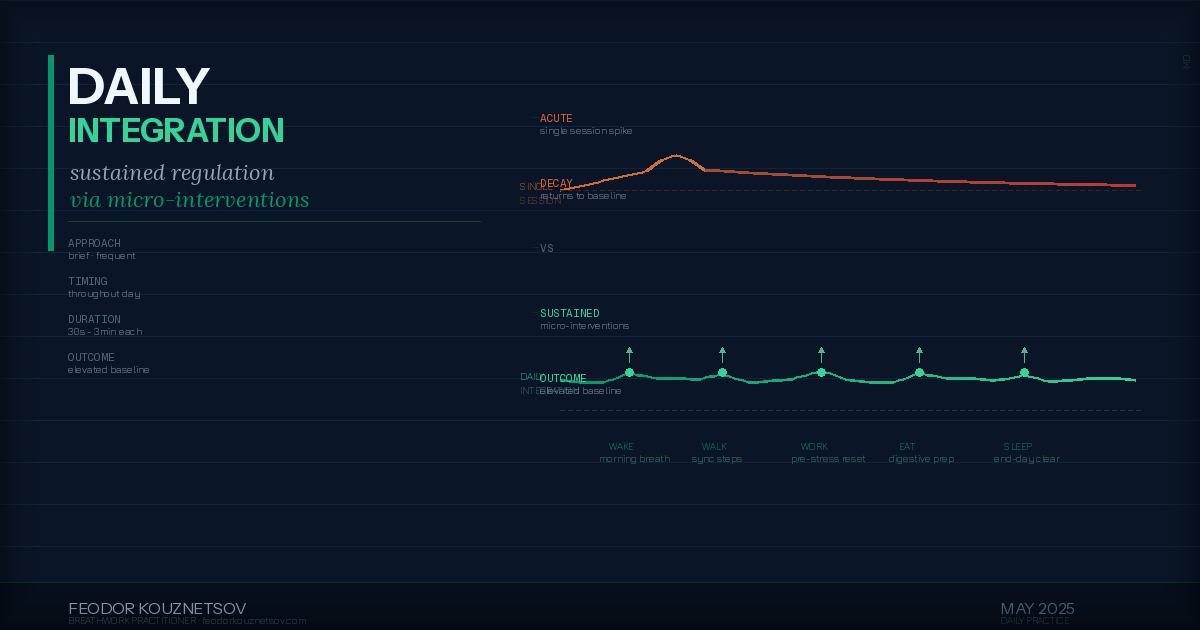
A 20-minute breathwork session shifts your nervous system state acutely. Heart rate variability increases, cortisol drops, sympathetic output decreases. These effects are measurable and real. But they are also temporary. Within hours, the baseline state reasserts itself unless something maintains the shift.
This is not a flaw in the practice. It is how homeostasis works. The nervous system has a default set point it returns to, and changing that set point requires consistent input over weeks and months. A single daily session is better than nothing, but it is not sufficient to shift the baseline if the rest of the day involves patterns that reinforce the old state — shallow breathing, chronic tension, hypervigilance.
Daily integration is not about adding more formal practice. It is about embedding brief interventions into activities you already do, so that the nervous system receives consistent signals throughout the day rather than a single acute input followed by 23 hours of reverting to old patterns.
Start With Awareness, Not Intervention
Before attempting to change anything, track your breathing patterns throughout the day for at least a week. Notice:
- When you shift from nasal to mouth breathing
- When you hold your breath (common during concentration, decision-making, or conflict)
- When your breathing becomes rapid or shallow (stress, email, scrolling)
- When your exhale shortens relative to your inhale (sympathetic dominance)
This is data collection, not self-criticism. You are identifying the specific moments when your breathing pattern shifts in ways that maintain sympathetic activation or reduce vagal tone. These are the intervention points where brief breathwork has the highest leverage.
Practical Integration Points
The following are not rituals or spiritual practices. They are micro-interventions timed to moments when your nervous system is most likely to default to old patterns. Each one takes 30 seconds to 3 minutes and produces a measurable shift in autonomic state.
Morning: Establish Baseline Vagal Tone
Before checking your phone or starting your day, establish parasympathetic tone that carries into the morning. This is not about "presence" or "intention-setting." It is about giving the nervous system a parasympathetic start rather than beginning the day in sympathetic activation.
Technique: 5-10 rounds of extended exhalation breathing
- Inhale through nose: 4 seconds
- Hold: 2 seconds
- Exhale through nose: 6-8 seconds
Mechanism: Extended exhalation activates vagal efferents that reduce heart rate and signal the brainstem to shift toward parasympathetic dominance. Starting the day in this state reduces baseline cortisol and improves HRV for hours afterward.
Walking: Synchronise Breath and Movement
Walking is rhythmic movement, which already entrains the nervous system. Adding breath synchronisation amplifies the effect and prevents the mental rumination that often accompanies walking.
Technique: Match breath to steps
- Inhale: 4 steps
- Exhale: 6 steps
- Maintain nasal breathing throughout
Mechanism: This produces a breathing rate around 5-6 breaths per minute (depending on walking pace), which maximises heart rate variability and strengthens vagal tone. The rhythm prevents mind-wandering, and nasal breathing maintains CO2 levels that support oxygen delivery.
If 4:6 feels uncomfortable, start with 3:4 or 4:5. The goal is not a specific ratio but a rhythm where exhalation is longer than inhalation and you can sustain it without air hunger.
Before High-Stress Inputs: Reset the System
Email, meetings, difficult conversations, news — these are predictable moments where the nervous system ramps into sympathetic activation. A brief reset before these inputs prevents the activation from accumulating throughout the day.
Technique: 3 rounds of exhale emphasis with physiological sigh
- Inhale through nose: 5 seconds
- Hold: 2-3 seconds
- Exhale through mouth (audible sigh): 6-8 seconds
Mechanism: The physiological sigh (inhale followed by extended exhale with slight vocal activation) is one of the fastest ways to reduce sympathetic arousal. It expels CO2, activates vagal pathways, and signals the brainstem that the current state can shift. Three rounds are sufficient to measurably reduce heart rate and cortisol.
Before Eating: Activate Parasympathetic Digestion
Digestion requires parasympathetic activation. Eating while in sympathetic dominance impairs digestion, reduces nutrient absorption, and increases gut inflammation. A brief breathing intervention before meals shifts the system into the state where digestion functions optimally.
Technique: 5 rounds of slow nasal breathing
- Inhale through nose: 4 seconds
- Exhale through nose: 7-8 seconds
Mechanism: This shifts autonomic balance toward parasympathetic dominance, which increases gastric motility, enzyme secretion, and blood flow to the digestive tract. It also reduces the cortisol-driven gut inflammation that worsens when eating under stress.
End of Day: Clear Accumulated Activation
Even with micro-interventions throughout the day, some sympathetic activation accumulates. The end-of-day practice clears this and signals the nervous system that the active period is over.
Technique: Lying down, extended exhalation with pursed lips
- Place one hand on chest, one on abdomen
- Inhale through nose, feeling both hands rise
- Exhale through pursed lips (like fogging glass), extending the exhale as long as comfortable
- Continue until you feel the shift (usually 5-10 breaths)
Mechanism: Pursed-lip breathing creates back-pressure in the airways that slows breathing rate and increases alveolar CO2, which enhances oxygen delivery and activates vagal pathways. The supine position reduces cardiac workload and facilitates the shift into sleep-conducive nervous system state.
What Changes Over Time
Within 2-4 weeks of consistent daily integration, you will notice:
- Baseline heart rate variability increases (measurable if you track HRV)
- Recovery from stress is faster — you return to baseline in minutes rather than hours
- Chronic tension reduces, particularly in the jaw, neck, and chest
- Sleep quality improves (easier onset, fewer night wakings)
- The default breathing pattern shifts — nasal breathing becomes automatic, breathing rate slows
These are not subjective improvements. They are objective changes in nervous system function that occur when the system receives consistent regulatory input throughout the day rather than a single acute intervention.
This Is Not Meditation
Daily breath integration is often confused with mindfulness or meditation, but the mechanism is different. Meditation is attention training. Breathwork is autonomic regulation. Both are valuable, but they are not the same thing.
You do not need to be "present" or "mindful" for these interventions to work. You need to execute the technique correctly — the nervous system responds to the input regardless of whether your mind is calm or chaotic. The benefit is physiological, not psychological.
When to Add Formal Practice
Daily integration maintains the baseline established by formal practice. It is not a substitute. If you are working with chronic conditions, anxiety, or significant nervous system dysregul
Next step
Want to work through your situation personally?
Disclaimer: personal experience & self-regulation practices. Not medical advice.