OCD and Thought Loops — Why the Body Is the Way Out

The Loop That Thinking Cannot Stop
If you have OCD, you already know that trying to think your way out of a thought loop does not work. You have probably tried arguing with the thought, reassuring yourself, distracting yourself, waiting it out. The loop returns — often stronger than before, because the effort of resisting it adds its own layer of activation.
This is not a failure of willpower or intelligence. It is a predictable consequence of what is actually happening neurologically. Understanding the mechanism does not immediately stop the loop, but it changes the approach — and that change in approach is where the practical work begins.
What Is Actually Happening in the Brain
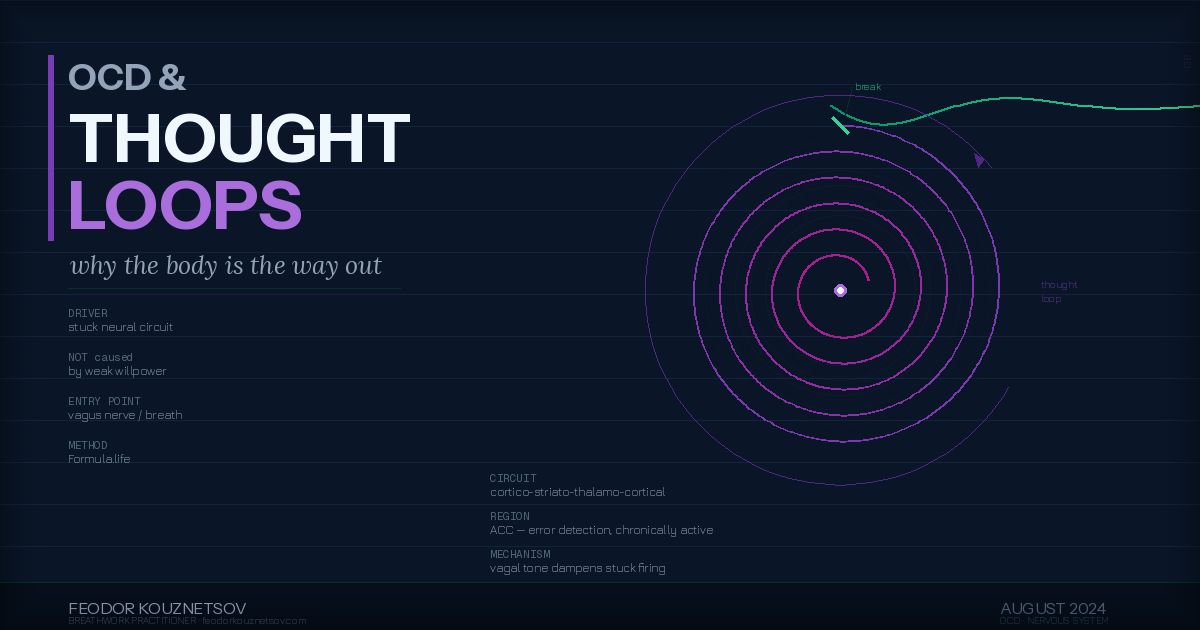
OCD involves hyperactivation of a circuit called the cortico-striato-thalamo-cortical loop — a pathway that, in a well-regulated brain, acts as a filter. It evaluates incoming signals, decides which ones need attention, and moves on. In OCD, this circuit gets stuck in a repetitive firing pattern. The brain keeps flagging the same thought as requiring attention and response, even after it has been addressed many times.
The anterior cingulate cortex — a region involved in error detection and conflict monitoring — is chronically overactive in OCD. It keeps generating a signal that something is wrong, unresolved, threatening. The thought loop is the subjective experience of this stuck circuit.
This is why cognitive approaches, while valuable, have a ceiling. You can learn to identify a thought as irrational. You can know intellectually that the fear is disproportionate. And the circuit keeps firing anyway, because the signal is not coming from the reasoning part of the brain — it is coming from deeper regulatory systems that do not respond to logical argument.
The thought loop is a nervous system event that presents itself as a thinking problem. Treating it only at the level of thought is addressing the symptom, not the mechanism.
Where Breathing Comes In
The vagus nerve connects the brainstem to most of the major organs — including the heart, lungs, and gut — and runs bidirectional signals between the body and the brain. When vagal tone is high, the brain's threat-detection systems are dampened. The anterior cingulate cortex quietens. The stuck circuit has less fuel.
Slow, nasal, diaphragmatic breathing is one of the most direct ways to increase vagal tone rapidly. Extended exhalation in particular activates the parasympathetic branch of the autonomic nervous system, reducing the physiological activation that sustains thought loops. This is not relaxation in a vague sense — it is a specific intervention in the circuit that is generating the loop.
There is a second mechanism worth understanding. Breathwork requires genuine interoceptive attention — focus on the physical sensations of breathing, on the body rather than the thought. This competes for attentional resources with the thought loop. Not by suppression, which strengthens the loop, but by redirection to a different signal that the brain can actually process and complete. The breath gives the nervous system something to do other than repeat.
Why This Works When Meditation Often Does Not
Many people with OCD find traditional mindfulness meditation counterproductive. Sitting quietly with instructions to observe your thoughts without engaging them can, for an already activated OCD brain, simply intensify the loop. Observation requires a baseline of nervous system regulation that the person does not yet have. You cannot observe from a neutral position if the circuit is in full activation.
Breathwork works differently because it starts with the body rather than the mind. It gives the nervous system a concrete physical task — regulate the breath — that does not depend on first achieving calm. The regulation follows the practice, rather than being a prerequisite for it.
This also makes it genuinely portable. The thought loops that OCD produces do not wait for a quiet room and twenty minutes of uninterrupted time. A breathing intervention that works in a busy environment, in the middle of a difficult moment, is one that can actually be used when it is needed.
Exposure and Response Prevention — and What Breathing Adds
Exposure and Response Prevention (ERP) is the most evidence-based treatment for OCD, and I want to be direct about that. If you have access to a qualified therapist working with ERP, that is the foundation. Breathwork is not a replacement for it.
What breathwork adds is a tool for managing the physiological activation that makes ERP difficult to sustain. ERP requires tolerating significant discomfort — deliberately exposing yourself to the trigger without performing the compulsion. The vagal activation produced by regulated breathing raises the threshold at which the nervous system moves into full activation, making the toleration more achievable. The two approaches work well together precisely because they address different layers of the same problem.
What the Practice Actually Looks Like
For OCD specifically, the most effective breathing approaches are those that prioritise extended exhalation and nasal breathing over any kind of activating technique. Kapalabhati and other forceful breathing methods can worsen OCD symptoms — the CO2 drop they produce increases nervous system excitability, which is the opposite of what is needed.
Simple coherent breathing — around five to six breath cycles per minute, with the exhalation slightly longer than the inhalation — produces measurable HRV improvement and vagal activation within minutes. Humming on the exhalation (Bhramari) is particularly effective because it combines extended exhalation with direct vagal stimulation through the larynx. Both can be practiced anywhere, silently or quietly, without equipment.
The key variable is consistency. A five-minute practice done daily for several weeks produces genuine nervous system change. A longer practice done once a week does not. The circuit that sustains thought loops recalibrates slowly — it requires repeated signal input over time to shift its baseline.
Where to Start
If OCD or persistent thought loops are something you are working with, the assessment is a useful first step — it gives me a concrete picture of your current nervous system state, breathing patterns, and the context around your symptoms, which means any work we do together starts from somewhere specific.
If you want to work directly on building a practice that addresses the physiological layer of OCD, individual sessions are where I do the most tailored work. The breathing approach for OCD is different in important ways from general stress management, and getting those specifics right from the beginning matters more than starting with any technique and hoping it fits.
The loop is not permanent. It is a stuck circuit, and stuck circuits can be unstuck — but usually not by thinking harder about them.
Where Formula.life Comes In
The breathing method I use in my work — Formula.life — was developed specifically to address the physiological layer of thought loops. It is not a generic relaxation technique. It is a structured approach to interrupting the stuck circuit through breath, body, and nervous system regulation, designed to work in real conditions: at work, mid-loop, without a quiet room or twenty minutes of preparation.
If OCD or persistent thought loops are something you are working with, the assessment gives me a concrete picture of your current nervous system state and breathing patterns before we work together. And if you want to start directly, individual sessions are where I apply the Formula.life method to your specific pattern — because the approach for OCD differs in important ways from general stress work, and getting those specifics right from the beginning matters.
Next step
Want to work through your situation personally?
Disclaimer: personal experience & self-regulation practices. Not medical advice.