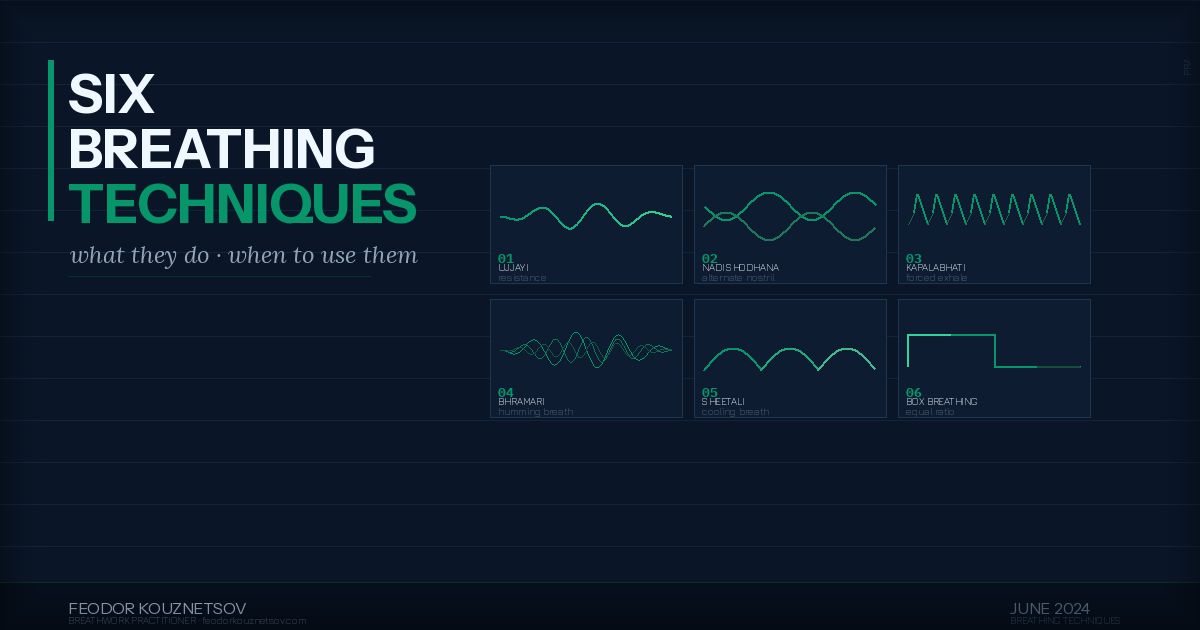
Six Breathing Techniques Worth Knowing — What They Do and When to Use Them
Breathing Techniques Without the Philosophy
Pranayama is a Sanskrit term that gets used a lot in yoga contexts, usually wrapped in language about life force energy and spiritual balance. I am going to set all of that aside, because underneath the framing there are genuinely useful breathing techniques — some of which have been studied in clinical settings and have clear physiological explanations for why they produce the effects they do.
I use several of these regularly, and I teach versions of them in my work with people managing chronic conditions, anxiety, ADHD, and autoimmune diseases. What matters is not the tradition they come from but what they actually do to your nervous system, your CO₂ tolerance, your vagal tone, and your breathing mechanics.
Here are six worth knowing.
1. Ujjayi — Resistance Breathing
Ujjayi involves breathing through the nose with a slight constriction at the back of the throat — enough to create a soft, audible friction on both inhale and exhale. In yoga classes it is sometimes called "ocean breath" because of the sound it produces.
What it actually does: the throat constriction creates mild airway resistance, which slows the breath and increases the work of the respiratory muscles. This resistance breathing pattern has been shown to increase activation of the parasympathetic nervous system and improve HRV. It also extends both phases of the breath naturally, which strengthens the vagal braking signal on exhalation.
When to use it: during movement, exercise, or any situation where you want to maintain a calm nervous system state under physical demand. It is also useful for people who tend to breathe too fast at rest — the resistance provides a natural governor.
2. Nadi Shodhana — Alternate Nostril Breathing
This technique involves using the thumb and ring finger to alternately close one nostril at a time, breathing in through one side and out through the other in a regular alternating pattern.
What it actually does: the two nostrils have slightly different connections to the autonomic nervous system — right nostril breathing tends to be slightly more activating, left nostril slightly more calming. Alternate nostril breathing cycles evenly between both, and research suggests it has a balancing effect on autonomic tone. It also forces nasal breathing and slows respiratory rate, both of which independently support nervous system regulation.
When to use it: before situations requiring focus and composure — presentations, difficult conversations, before sleep when the mind is running. Five minutes is enough to produce a measurable shift.
3. Kapalabhati — Forced Exhalation Breathing
Kapalabhati involves sharp, forceful exhalations through the nose driven by rapid contractions of the abdominal muscles, with passive inhalations in between. The pace is faster than normal breathing — typically one exhalation per second or faster.
What it actually does: the forced exhalations actively engage the diaphragm and abdominal muscles in a way that passive breathing does not. It temporarily lowers CO₂ and increases oxygen delivery, producing a sense of alertness and heightened mental clarity. It also trains the expiratory muscles, which are often underused in people with shallow breathing habits.
When to use it: as a morning activating practice, or when you need to shift out of a foggy, low-energy state. It is not suitable for people prone to anxiety or hyperventilation — the CO₂ drop can temporarily worsen symptoms in those cases. If you have a chronic condition involving inflammation, start very cautiously and notice how your body responds.
4. Bhramari — Humming Breath
Bhramari involves exhaling with a steady humming sound — a continuous "mmmm" through a gently closed mouth. The inhalation is normal nasal breathing; the exhalation is the hum.
What it actually does: humming on exhalation dramatically increases nitric oxide production in the nasal sinuses — studies have shown up to a fifteen-fold increase compared to silent exhalation. Nitric oxide has vasodilatory and anti-inflammatory effects and plays a role in immune regulation. Beyond that, the extended humming exhalation activates the vagus nerve directly via the larynx and vocal cords, producing rapid parasympathetic activation. This is closely related to the mechanism I use in Body Whisper Sessions.
When to use it: this is one of the most immediately effective techniques for acute stress, anxiety, or nervous system dysregulation. Even two or three minutes produces a noticeable shift. It is also one of the safest techniques across different conditions and states.
5. Sheetali — Cooling Breath
Sheetali involves inhaling through a rolled tongue (or pursed lips if tongue rolling is not anatomically possible), then exhaling slowly through the nose. The air passing over the wet surface of the tongue creates a genuine cooling effect in the mouth and throat.
What it actually does: the cooling sensation activates thermoreceptors that feed into the vagal pathway, contributing to a calming effect. The extended, controlled inhalation also encourages fuller diaphragmatic breathing. It is particularly useful when the body is running hot — whether from physical exertion, environmental heat, or emotional activation.
When to use it: in hot weather, after exercise, or during moments of anger or intense frustration when the physiological arousal has a genuine heat component. Less useful in cold environments or for people who run cold.
6. Box Breathing — Equal Ratio Breathing
I am including box breathing here rather than Anulom Vilom, which is essentially a variation of technique two above. Box breathing — equal counts of inhale, hold, exhale, hold, typically four seconds each — is the most widely studied structured breathing technique outside of clinical settings. It is used in military, emergency services, and performance contexts precisely because it is simple, reliable, and works under pressure.
What it actually does: the equal ratio pattern, combined with the breath holds, creates a rhythmic CO₂ fluctuation that trains CO₂ tolerance over time. The holds briefly allow CO₂ to rise, which strengthens the chemoreceptor response — meaning you become less reactive to CO₂ changes and therefore less prone to anxiety responses driven by breathing irregularity. It also produces strong HRV coherence when practiced at around four to six breath cycles per minute.
When to use it: before high-stakes situations, during moments of acute stress, or as a daily nervous system maintenance practice. It is one of the most transferable techniques — easy to do anywhere, no particular posture required.
How to Actually Start
The most common mistake with breathing techniques is trying several at once, practicing inconsistently, or picking a technique without knowing what state you are trying to shift from or toward. Bhramari and box breathing are where I would suggest most people start — they are safe across a wide range of conditions, produce noticeable effects quickly, and build the foundational skills that make the other techniques more accessible.
A breathing technique practiced for five minutes daily for a month will do more than any technique practiced intensively for a single week. The nervous system responds to consistency, not effort.
If you want to explore these techniques with some structure and real-time guidance, I have a free breathing practice tool at feodorkouznetsov.com/breathe — it is a good place to experience several of these patterns directly rather than just reading about them. And if you want to understand your own baseline before experimenting, take the assessment — it covers breathing, physical state, inflammation markers, and lifestyle factors and gives me what I need to point you in the right direction.
Next step
Want to work through your situation personally?
Disclaimer: personal experience & self-regulation practices. Not medical advice.