Why Voluntary Elimination of Deep Breathing Is Harder Than It Sounds
What VELD Actually Means
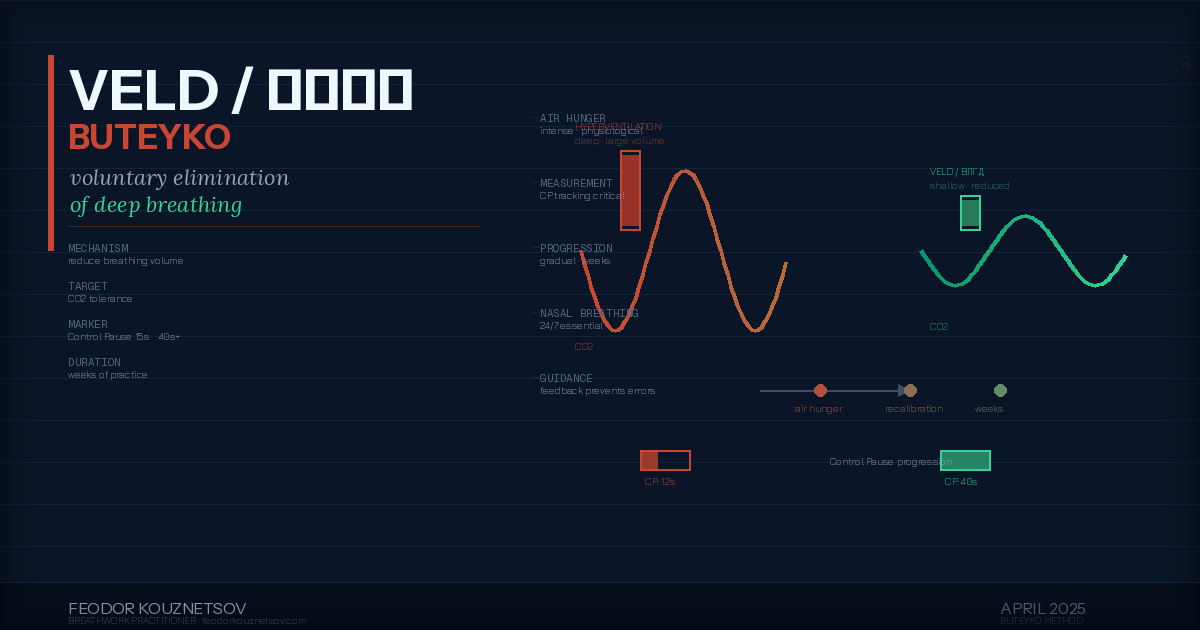
VELD — Voluntary Elimination of Deep Breathing — is the term Konstantin Buteyko used in Russian to describe his method. In English-language contexts, it is usually just called "the Buteyko method," but VELD makes the mechanism explicit: you are voluntarily reducing the depth and volume of your breathing to restore normal CO2 levels and improve oxygen delivery through the Bohr Effect.
I covered the mechanism in detail in two earlier posts — one on what actually changes and one on how it leverages the Bohr Effect. This post addresses the practical question: why does self-directed VELD practice fail for most people, and what does it take to make it work?
Why the Instructions Sound Simple
The core instruction is straightforward: breathe less. Reduce tidal volume. Slow your breathing rate. Breathe through your nose at all times. Practice breath holds to increase CO2 tolerance. Over weeks, your Control Pause will increase, your symptoms will reduce, and your baseline respiratory chemistry will shift.
This is accurate. It is also insufficient. The gap between understanding the instruction and executing it consistently is where most people fail.
The Real Challenges
1. Air Hunger Is Not Subtle
When you first reduce breathing volume, the sensation of air hunger is intense. It feels like suffocation. Your instinct — reinforced by years of overbreathing — is to override it and take a deep breath. Most people interpret the discomfort as a signal that they are doing something wrong, when in fact it is a signal that the chemoreceptors in the brainstem are recalibrating to higher CO2 levels.
This is not a minor psychological hurdle. It is a physiological alarm bell that has been calibrated to a low-CO2 baseline for years or decades. Overriding it requires understanding what is happening and tolerating significant discomfort without panicking. Most people cannot do this alone in the first few weeks.
2. You Cannot Measure What You Cannot Feel
The Control Pause — the number of seconds you can comfortably hold your breath after a normal exhalation — is the primary measurement in VELD practice. It is a direct indicator of CO2 tolerance. When you start, your CP might be under 15 seconds. The goal is to raise it above 40 seconds, which corresponds to a respiratory chemistry that supports healthy oxygenation and reduces symptoms.
The problem is that "comfortable" is subjective. People who are used to chronic hyperventilation often misjudge the point where they need to breathe. They either push too hard (which produces panic and cortisol spikes) or stop too early (which produces no training effect). Without feedback, you do not know whether you are measuring accurately or whether your practice is producing the changes you need.
3. The Temptation to Do Too Much
VELD is a gradual practice. You reduce breathing volume slightly, maintain that for days or weeks until it becomes comfortable, then reduce slightly more. The progression is slow because the chemoreceptors need time to adapt.
Most people, once they understand the mechanism, want to accelerate. They hold their breath longer, breathe more shallowly, and push harder than their current CO2 tolerance supports. This produces symptoms — dizziness, anxiety, increased heart rate — that make them think the method is not working or is unsafe, and they quit.
The method works. But it requires precision in dosing the intervention, and self-directed practice almost always involves either underdosing (no effect) or overdosing (aversive symptoms that stop practice).
4. Nasal Breathing Is Non-Negotiable
Mouth breathing, even occasionally, undermines VELD practice. The mouth creates no resistance, which allows larger tidal volumes and faster breathing rates. This lowers CO2 and perpetuates the hyperventilation pattern you are trying to correct.
For people with chronic nasal congestion, structural issues, or habitual mouth breathing during sleep, nasal breathing feels impossible. But it is the foundation of the method. If you cannot maintain nasal breathing consistently — including during sleep — the practice will not work. This often requires addressing nasal patency issues (decongestants, saline rinses, structural correction) before VELD practice can be effective.
What Makes Guided Practice Different
Guided VELD practice — whether through in-person instruction or structured sessions — addresses the specific failure points that stop self-directed practice:
- Baseline measurement — Accurate assessment of your starting Control Pause and breathing rate so the practice is dosed correctly
- Incremental progression — Clear benchmarks for when to increase difficulty, preventing both underdosing and overdosing
- Feedback on technique — Real-time correction when you are holding too long, breathing too shallowly, or misinterpreting air hunger signals
- Troubleshooting nasal patency — Practical interventions for chronic congestion or structural issues that block nasal breathing
- Managing the recalibration period — Support through the first 2-4 weeks when air hunger is most intense and the temptation to quit is highest
This is not about making the method more complicated. It is about preventing the errors that stop people from practicing long enough for the method to work.
The Role of Formula.life
The Formula.life app includes a Buteyko Mode specifically designed for VELD practice. It is not a substitute for understanding the method, but it is a useful tool once you know what you are doing. The app provides:
- Paced breathing at rates that support CO2 retention
- Timed breath holds with progression built in
- Tracking for Control Pause measurements over time
The app is most useful for people who already understand VELD principles and need a structured practice tool. For people starting from scratch, it does not replace the need for initial guidance to establish correct technique.
Who VELD Practice Is For
VELD is particularly effective for conditions where chronic hyperventilation is the primary mechanism:
- Asthma and obstructive airway disease
- Anxiety and panic disorder
- Sleep disturbances including sleep apnoea
- Chronic fatigue and exercise intolerance
- Inflammatory conditions where CO2 balance affects symptoms (including AS, which I manage with this approach)
These are not the only applications, but they are the clearest ones. If your symptoms worsen with stress, improve with slow breathing, or involve breathlessness despite normal oxygen levels, VELD is likely relevant.
Starting VELD Practice Correctly
If you want to work on VELD specifically, the assessment gives me your baseline breathing patterns and Control Pause so I can tell you where to start. And individual sessions are where I guide the practice directly — measuring your baseline, correcting technique, and adjusting progression based on how your body responds rather than following a generic protocol.
The method is not complicated intellectually. But it requires precision in execution, feedback during the recalibration phase, and troubleshooting when the standard approach does not work. That is what guided practice provides.
VELD works. But only if you practice it correctly, consistently, and long enough for the chemoreceptors to adapt. Most people quit before they reach that point because they do not have the support to navigate the challenging early weeks. That is what this work addresses.
Next step
Want to work through your situation personally?
Disclaimer: personal experience & self-regulation practices. Not medical advice.