How Early Attachment Patterns Create Chronic Nervous System Holding — And How to Release Them

Why Early Relationships Matter to the Nervous System
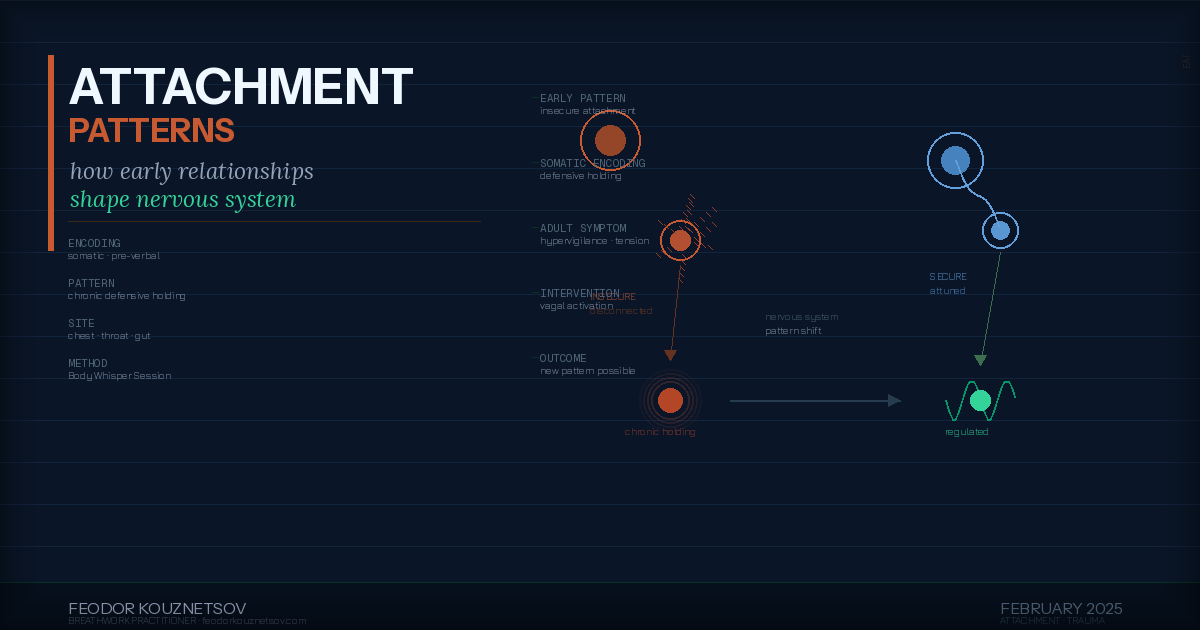
The nervous system develops its threat-detection and safety-signalling capacity in the context of early relationships. An infant whose distress is consistently met with calm, attuned responses learns that the world is safe enough, that their signals are effective, and that they can return to baseline after dysregulation. An infant whose distress is met with inconsistency, absence, or hostility learns something different: that the world requires constant vigilance, that their signals are ineffective, and that baseline is a state of activation rather than rest.
This is not psychological theory. It is developmental neuroscience. The patterns established in early attachment become the template for how the autonomic nervous system operates throughout life. Secure attachment correlates with high vagal tone, good HRV, and a nervous system that can move fluidly between activation and rest. Insecure attachment — particularly disorganised attachment — correlates with chronic sympathetic dominance, low HRV, and a nervous system stuck in defensive mode.
These patterns are encoded somatically. They live in the body as chronic muscle bracing, shallow breathing, hypervigilance, difficulty relaxing even in objectively safe contexts, and a baseline sense that something is always wrong even when nothing demonstrably is. This is what people are referring to when they talk about "attachment wounds" or "unresolved childhood trauma" — they are describing nervous system patterns established early and maintained chronically.
How It Manifests in Adult Life
The somatic holding patterns that result from insecure early attachment show up in predictable ways:
- Chronic tension in the chest, throat, or jaw — areas associated with self-expression and vulnerability
- Difficulty breathing deeply — the body remains in a state of shallow, guarded breathing even at rest
- Hypervigilance and scanning — the nervous system never fully relaxes, always monitoring for threat
- Difficulty with intimacy — closeness triggers defensive activation because early closeness was paired with threat or neglect
- Low interoceptive awareness — the body has learned to suppress internal signals because attending to them in childhood often meant attending to unmet needs or distress that would not be resolved
These are not character flaws or personality traits. They are adaptive responses to early environments that have become maladaptive in adulthood. The nervous system is doing exactly what it was trained to do — it is just operating on outdated threat assessments.
Why Cognitive Approaches Often Miss This
Traditional talk therapy can help people understand their attachment patterns intellectually. You can learn that your hypervigilance comes from an unpredictable early environment, that your difficulty trusting comes from inconsistent caregiving, that your need for control comes from early powerlessness. This knowledge is useful. But it often does not shift the somatic holding because the holding is not maintained by beliefs — it is maintained by autonomic patterns that operate below conscious awareness.
You cannot think your way out of a nervous system pattern that was established pre-verbally and is maintained autonomically. The work has to reach the layer where the pattern is actually encoded, which is the body.
How the Body Whisper Session Addresses This
The Body Whisper Session works with attachment-related somatic holding through the same mechanism it uses for chronic pain and anxiety: vagal activation combined with interoceptive awareness in a context of safety. The process is covered in detail in this post on the mechanism, but the application to attachment patterns is worth making explicit.
When the nervous system is in chronic defensive mode due to early attachment patterns, it requires two things to shift: a signal of safety strong enough to override the default threat assumption, and an opportunity to process the somatic holding that has accumulated. The Body Whisper Session provides both.
The voice work — slow, resonant, delivered close to the ear — activates vagal pathways that signal safety at a neurophysiological level. This is not about convincing you that you are safe. It is about giving the brainstem the input it needs to reduce sympathetic output and shift into parasympathetic dominance. In that state, the chronic bracing, the shallow breathing, the guarded posture can begin to release.
The interoceptive guidance brings awareness to the areas where the attachment patterns are held somatically — the chest, the throat, the gut, the shoulders. When you bring conscious awareness to these areas while the nervous system is receiving safety signals, the body has the information it needs to update its threat assessment and release the holding pattern.
What This Work Looks Like in Practice
People working on attachment-related holding often describe sensations during sessions that are different from what comes up with purely physical pain. There is frequently an emotional component — grief, anger, longing — that surfaces as the somatic holding releases. This is not a problem. It is the nervous system processing material that has been held in a defensive freeze state, sometimes for decades.
The work is not about reliving childhood experiences or analysing relationships. It is about creating the conditions where the body can release what it has been holding and the nervous system can establish new patterns based on current reality rather than early threat.
This does not happen in one session. Attachment patterns were established over years and reinforced through thousands of interactions. Shifting them requires consistent input over time — repeated experiences of safety, repeated opportunities for the nervous system to practice operating outside of defensive mode, repeated reinforcement that the old patterns are no longer necessary.
Who This Work Is For
This approach is relevant if you recognise patterns in yourself that trace back to early relationships:
- Chronic difficulty relaxing or feeling safe, even in objectively secure situations
- Patterns of hypervigilance, control, or scanning for threat
- Difficulty with intimacy, vulnerability, or emotional expression
- Somatic symptoms (chest tightness, throat constriction, shallow breathing) that worsen in relational contexts
- A sense that "something is always wrong" that you cannot articulate or resolve
This is not a substitute for trauma therapy if you are working with acute or complex PTSD. But for people whose early attachment patterns have created chronic nervous system dysregulation that shows up somatically, the Body Whisper Session addresses the layer where the pattern is maintained.
Working With This
Before we work together, I ask everyone to complete the assessment, which gives me context about your current nervous system state and the patterns you are managing. Sessions are conducted online, and the work translates effectively through video — the voice and interoceptive guidance produce the same physiological effects remotely.
If you want to work on this directly, session details and availability are on the sessions page. And if you are not sure whether this is the right approach for your situation, get in touch — I will tell you honestly whether I think this work will help.
The patterns established in early attachment are not permanent. The nervous system retains the capacity for change throughout life. What it needs is the right input, consistently applied, in a context where safety is not just talked about but experienced at a physiological level. That is what this work provides.
Next step
Want to work through your situation personally?
Disclaimer: personal experience & self-regulation practices. Not medical advice.