How the Body Whisper Session Works — The Nervous System Mechanism Explained
What the Body Whisper Session Actually Does
The Body Whisper Session is a voice-based practice that combines breathwork with interoceptive guidance to shift chronic nervous system patterns. I covered the origin and development of the method in an earlier post. This post explains the mechanism — what is happening at the level of the nervous system that produces the effects people consistently report.
The effects are not subtle. People describe significant reductions in chronic pain, release of muscle tension they have carried for years, resolution of anxiety that has been constant, and a quality of bodily awareness that feels entirely new. These are not placebo responses. They are the result of specific interventions on specific nervous system pathways, and understanding the mechanism makes the practice replicable rather than mystical.
The Connectome and Why Neural Connectivity Matters
The term connectome refers to the comprehensive map of neural connections in the brain and nervous system — every pathway, every synapse, every circuit that allows neurons to communicate. It is one of the most active areas of neuroscience research, and understanding it has implications for everything from developmental disorders to chronic pain.
The Body Whisper Session does not literally map your connectome. But the concept matters because chronic conditions — particularly pain, anxiety, and somatic holding patterns — are maintained by specific neural circuits that have become reinforced through repetition. These circuits are part of the connectome, and they are responsive to inputs that shift nervous system state.
When we talk about "rewiring" or "releasing" a pattern, what we are describing is neuroplasticity operating within the connectome — the brain and nervous system's capacity to form new connections and weaken old ones based on experience. The Body Whisper Session creates the conditions where maladaptive circuits can be interrupted and new, healthier patterns can form. This is not abstract. It is how the nervous system works.
The Problem: Chronic Defensive Holding
Chronic pain, persistent muscle tension, and many forms of anxiety are maintained by the nervous system being locked in a defensive state. This is not metaphorical. When the nervous system perceives threat — whether from actual danger, chronic stress, unresolved trauma, or inflammatory conditions — it activates protective patterns: muscle bracing, shallow breathing, hypervigilance, and suppression of interoceptive signals that might indicate vulnerability.
These patterns are adaptive in the short term. They protect you during acute threat. The problem is that they persist long after the threat has passed, becoming the baseline state. The nervous system remains in a mode designed for survival, not for healing or rest. And because the activation is maintained below conscious awareness, you cannot simply decide to stop it.
Traditional approaches — stretching, massage, cognitive reframing — often fail to reach this layer because they do not address the nervous system state that is generating the holding pattern. You can stretch a chronically tight muscle, but if the nervous system signal telling it to brace is still active, the tension returns within hours.
The Mechanism: Vagal Activation and Interoceptive Awareness
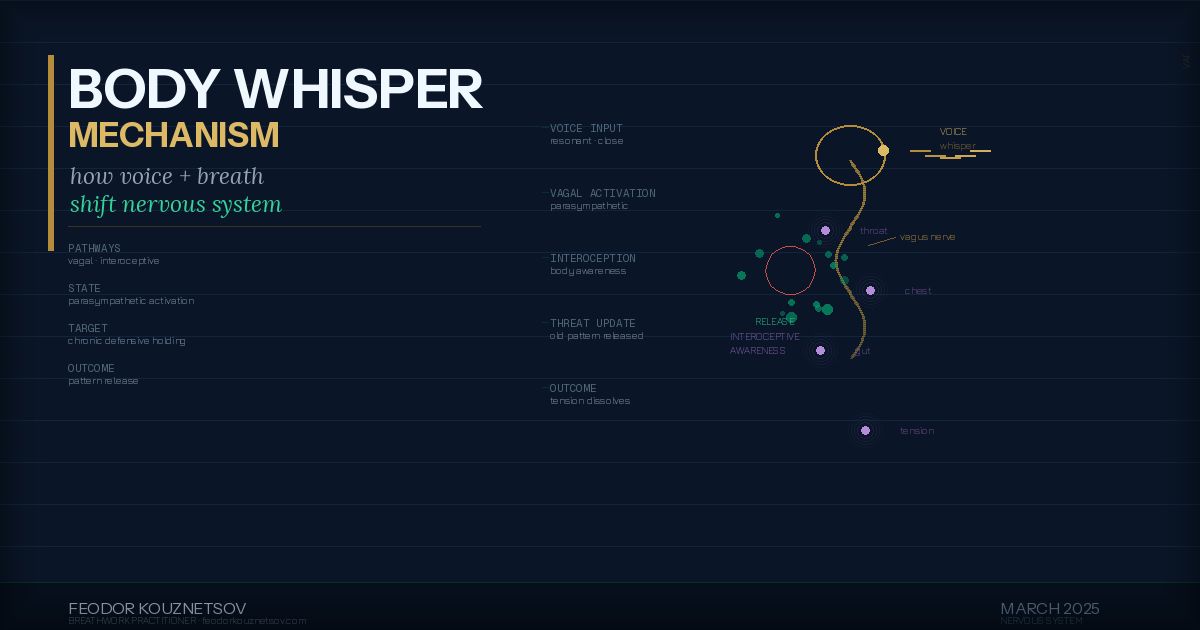
The Body Whisper Session works through two simultaneous pathways: vagal activation via voice and breath, and heightened interoceptive awareness through guided attention to internal bodily states.
Vagal Activation
The vagus nerve is the primary pathway of the parasympathetic nervous system — the branch responsible for rest, repair, and social engagement. It runs through the larynx, throat, and inner ear, which is why vocalisation and sound delivered close to the ear have a direct physiological effect.
Slow, resonant voice work activates vagal afferent fibres that signal safety to the brainstem. This is not suggestion. It is a direct neurophysiological input. When the brainstem receives consistent signals of safety from the vagus, it reduces sympathetic output — heart rate drops, cortisol production decreases, muscle tone softens, and the nervous system moves out of defensive mode.
The whisper specifically matters because it requires the listener to become still and attentive without triggering the startle response that louder sound can produce. It communicates proximity and safety simultaneously, which is the optimal input for vagal activation.
Interoceptive Awareness
Interoception is the sense of the internal state of the body — heart rate, breathing, muscle tension, temperature, gut sensations. In chronic defensive states, interoceptive awareness is typically suppressed. The body has learned that attending to internal signals often means attending to pain, discomfort, or vulnerability, so the default mode becomes ignoring those signals and operating on autopilot.
The Body Whisper Session guides attention systematically through the body — not forcing awareness, but inviting it. What happens when interoceptive awareness increases in the context of vagal activation is that the nervous system begins to receive accurate information about the current state rather than operating on outdated threat assumptions.
A chronically braced shoulder, for example, is being held in that state because the nervous system believes it needs to be protected. When you bring conscious awareness to the shoulder while simultaneously signalling safety via vagal pathways, the nervous system has the information it needs to release the holding pattern. The release is not willed. It happens as a result of the nervous system updating its threat assessment based on new interoceptive data in a safe context.
Why This Reaches Layers Other Approaches Miss
Most bodywork and most talk therapy operate at different layers. Bodywork addresses tissue directly but often does not shift the nervous system state generating the tension. Talk therapy addresses cognitive patterns but often does not reach the somatic holding that maintains those patterns.
The Body Whisper Session operates at the interface — using voice and breath to shift autonomic state, and using interoceptive guidance to give the nervous system the information it needs to release defensive patterns that are no longer serving a protective function.
This is why people often describe sensations during sessions that they have never experienced before — waves of heat, tingling, spontaneous muscle release, emotional surges that resolve quickly. These are not mystical experiences. They are the nervous system processing and releasing material that has been held in a defensive freeze state, sometimes for years.
The Role of Breathwork
The breathwork component of the session is not incidental. Controlled breathing — specifically extended exhalation and coherent breathing patterns — enhances vagal tone and maintains the parasympathetic state throughout the session. This creates the conditions where interoceptive exploration is safe rather than overwhelming.
Without the breathwork foundation, guiding someone's attention to areas of chronic pain or tension can increase distress rather than resolve it. The breath maintains the nervous system in a state where the body can process and release rather than defend and brace further.
What Conditions Respond
The Body Whisper Session is particularly effective for conditions where chronic nervous system activation is a core part of the mechanism:
- Chronic pain conditions (fibromyalgia, migraines, tension headaches, back pain)
- Autoimmune and inflammatory conditions where stress-inflammation feedback is active
- Anxiety and panic disorder where hypervigilance and somatic activation are constant
- Trauma-related somatic symptoms (PTSD, complex PTSD)
- Conditions involving chronic muscle bracing or postural holding patterns
These are not exclusive categories. Any condition where the nervous system is maintaining a chronic defensive state is potentially responsive to this work.
Working With Me
Sessions are conducted online via video call. The voice work and interoceptive guidance translate effectively through this format — you do not lose the physiological effect by being remote. Before we work together, I ask everyone to complete the assessment, which gives me the context I need to understand your baseline state and tailor the session accordingly.
If you are ready to book directly, session details and availability are on the sessions page. And if you are not sure whether this work is relevant to your situation, get in touch — I will tell you directly if I think I can help.
The mechanism is not complicated. But the execution requires precision, and the results require that the nervous system is in the right state to process what it has been holding. That is what the session creates: the conditions where release becomes possible.
Next step
Want to work through your situation personally?
Disclaimer: personal experience & self-regulation practices. Not medical advice.