How I Used Breathwork to Manage Ankylosing Spondylitis — The Epigenetics Story
The Diagnosis and What It Meant
I was diagnosed with Ankylosing Spondylitis in my twenties. For those unfamiliar, AS is an autoimmune inflammatory condition that primarily affects the spine and sacroiliac joints. The standard trajectory is progressive fusion of the vertebrae, chronic pain, reduced mobility, and lifelong medication — usually NSAIDs, sometimes biologics.
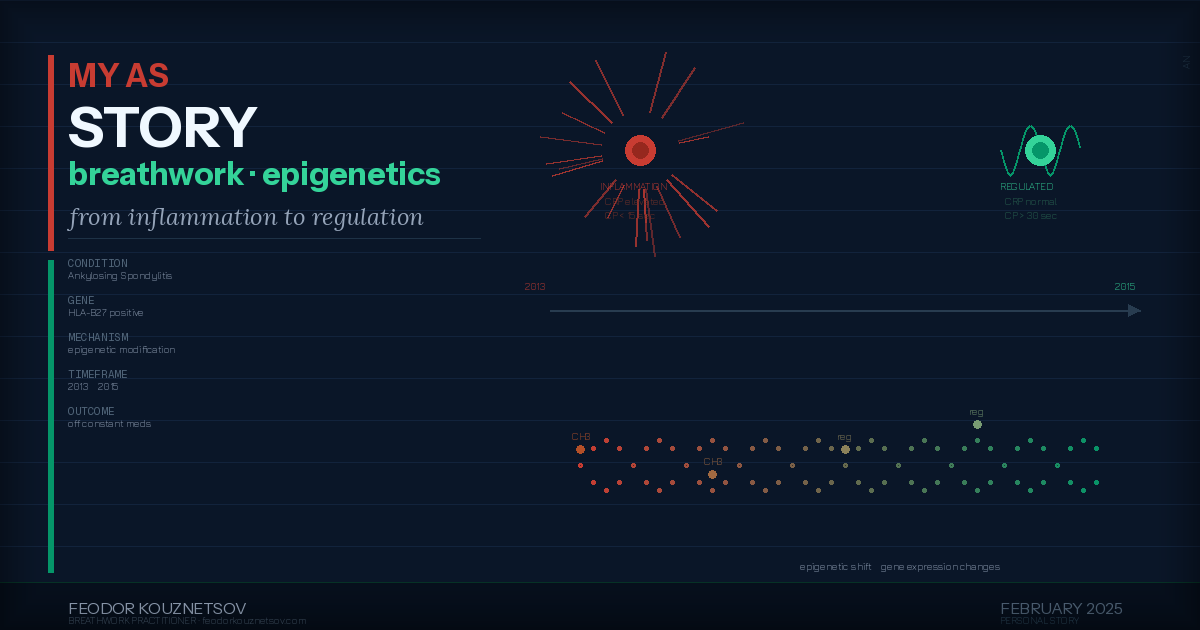
I took the medication. It managed some of the pain but did not address the underlying inflammatory state, and the side effects were accumulating. By 2013, I had reached a point where I was clear that this approach was not sustainable for me long-term. I needed to understand what was driving the inflammation at a deeper level and whether there were inputs I could control that would actually shift the disease activity rather than just suppress symptoms.
That was when I started looking seriously at epigenetics — not as a buzzword, but as a framework for understanding how environment, behaviour, and nervous system state influence gene expression in real time.
What Epigenetics Told Me About AS
AS has a strong genetic component — specifically the HLA-B27 gene, which I carry. But the majority of people who carry HLA-B27 never develop AS. Genetic predisposition is not the same as genetic determinism. What determines whether the disease expresses, and how actively, is largely epigenetic.
I covered the mechanisms in detail in two earlier posts — one on how chronic stress affects gene expression and one on the molecular mechanisms themselves. The core finding that mattered for me was this: chronic nervous system activation produces epigenetic modifications that upregulate inflammatory gene expression — specifically the IL-23/IL-17 axis that drives AS pathology — and suppress immune regulatory genes.
This meant that the inputs I gave my nervous system — stress levels, sleep quality, breathing patterns — were not peripheral lifestyle factors. They were direct inputs into the epigenetic machinery controlling how actively my disease was expressing.
Why Breathwork Was the Entry Point
Breathwork became the foundation of my approach for two reasons. First, it was the most direct tool I had for regulating my nervous system state. Chronic pain keeps the nervous system in sustained activation, which drives faster breathing, which lowers CO2, which impairs oxygen delivery and perpetuates the stress-inflammation feedback loop. Breaking that cycle required addressing the breathing pattern, and breathwork gave me a concrete practice I could do daily without equipment or supervision.
Second, breathwork was something I could measure. The Control Pause (a Buteyko measurement covered in this post) gave me a baseline. When I started, my CP was under 15 seconds — a clear indicator of chronic hyperventilation. Within three months of consistent practice, it was above 30. That shift was not subjective. It was a measurable change in respiratory chemistry, and it correlated directly with reduced pain and inflammation.
What the Practice Actually Looked Like
The breathwork I used was not complicated. I built it around three core techniques:
- Nasal breathing at all times — including during sleep, which required taping my mouth shut initially. This alone raised my baseline CO2 and reduced the hyperventilation pattern.
- Coherent breathing — 5-6 breath cycles per minute with equal inhalation and exhalation. This improved HRV and vagal tone measurably within weeks.
- Extended exhalation before sleep — shifting into parasympathetic dominance before bed, which improved sleep quality and reduced morning stiffness.
I practiced daily. Not when I felt like it, not when the pain was bad — daily, regardless. The consistency mattered more than the duration. A 10-minute session done every day for months produces real nervous system change. A 60-minute session done once a week does not.
What Changed and What Did Not
By 2015, I was managing AS without constant medication. The structural changes the disease had already caused did not reverse — fused joints do not unfuse. But the active inflammation reduced significantly. Morning stiffness, which had been severe, became mild and manageable. Pain levels dropped from a baseline of 6-7 out of 10 to 2-3, with flares becoming infrequent rather than constant.
Blood markers improved. C-reactive protein, which had been persistently elevated, normalised. This was not placebo — CRP is an objective inflammatory marker, and it responded to the intervention.
I want to be clear about what I am not claiming. I did not "cure" AS. The disease is still present. What shifted was the epigenetic layer — the degree to which inflammatory genes were actively expressing. That shift was enough to move from a state where medication was necessary for basic function to a state where it was not.
The Broader Implications
What worked for me — breathwork as the entry point, combined with sleep regulation, stress management, and an anti-inflammatory diet — is not unique to AS. The same epigenetic pathways are active in other autoimmune conditions, chronic pain states, and inflammatory diseases. The specifics of the practice vary depending on the condition and the person, but the principle is the same: consistent inputs that shift nervous system state produce epigenetic changes that affect disease expression.
This is not alternative medicine. It is applied physiology. The research on epigenetics and chronic disease is extensive and growing. What was missing for me was a practical framework for translating that research into something I could actually do. Breathwork provided that framework.
If You Are Managing a Chronic Condition
If you are dealing with an autoimmune condition, chronic pain, or persistent inflammation, understanding the epigenetic layer matters. It reframes the work from "managing symptoms" to "shifting the baseline state that determines how acti
Next step
Want to work through your situation personally?
Disclaimer: personal experience & self-regulation practices. Not medical advice.