Overbreathing — What It Is, Why It Happens, and How to Stop the Cycle
The Problem Nobody Notices Because It Feels Normal
Overbreathing — also called hyperventilation — means breathing more deeply or rapidly than your body's metabolism actually requires. It does not feel like a problem. For most people it feels like just how they breathe. That is precisely what makes it difficult to address.
I breathed incorrectly for over thirty years. Mouth breathing, chest breathing, a resting rate well above what was necessary — none of it felt wrong because it was all I had ever known. The consequences showed up elsewhere: in my nervous system, in the inflammation driving my Ankylosing Spondylitis, in a background level of tension and fatigue I had simply normalised. It was not until I understood the physiology of what overbreathing actually does that the pieces fell into place.
If you have read the post on the Bohr Effect, you already know the core mechanism: overbreathing depletes CO2 in the blood, which paradoxically impairs oxygen delivery to the tissues. This post goes further — into the causes, the symptoms that most people never connect to their breathing, and the practical steps for changing the pattern.
What Overbreathing Actually Does
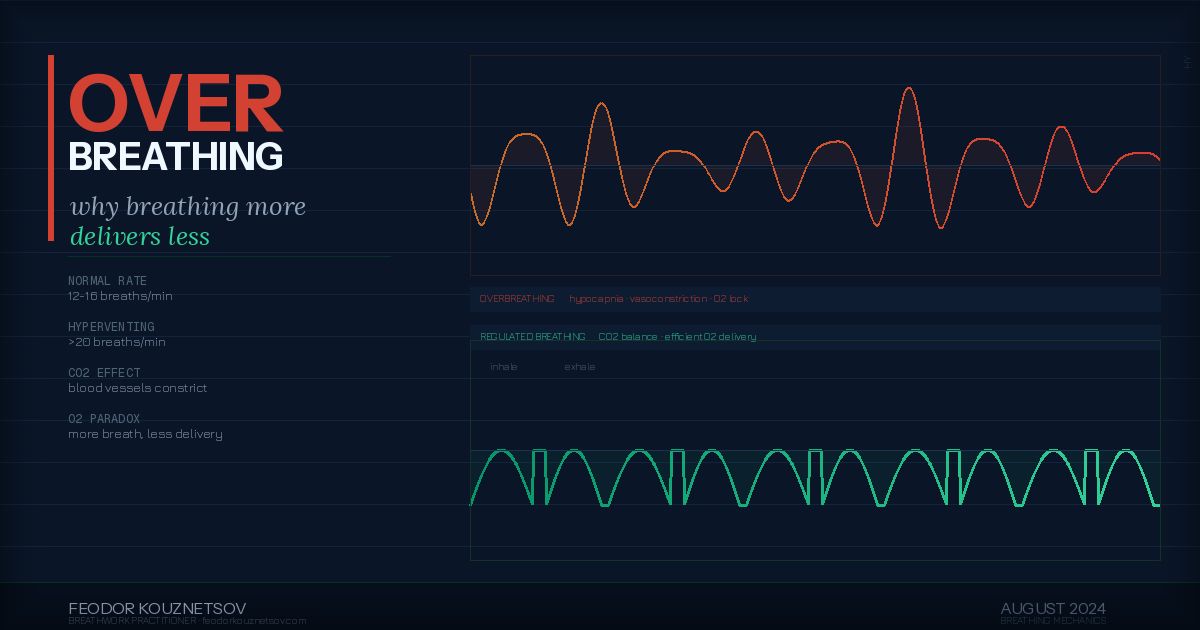
Under normal conditions, your breathing rate is regulated automatically to match your metabolic demand — the rate at which your cells are consuming oxygen and producing CO2. When you breathe more than this demand requires, CO2 is expelled faster than it is produced. Blood CO2 drops. This state is called hypocapnia.
Hypocapnia triggers a cascade of physiological responses, none of them helpful in a resting state:
- Blood vessels constrict — including those supplying the brain
- Haemoglobin holds onto oxygen more tightly (the Bohr Effect in reverse)
- Blood pH rises, shifting toward alkalosis
- The nervous system becomes more excitable and reactive
- Smooth muscle in the airways and blood vessels goes into spasm
The result is a body that is technically receiving plenty of oxygen but is delivering it inefficiently, running in a state of low-grade physiological alarm, and becoming progressively more sensitive to any further CO2 fluctuation.
What Causes Overbreathing
The triggers vary, but they fall into a few consistent categories.
Psychological stress and anxiety are the most common. The fight-or-flight response accelerates breathing as part of preparing the body for physical action. If the threat is psychological rather than physical — a difficult conversation, a deadline, a sustained period of worry — the breathing acceleration serves no purpose but continues regardless. Over time, the elevated breathing rate becomes the baseline.
Habitual patterns are the second major category, and the one most relevant to people who do not consider themselves anxious. Mouth breathing, chest breathing, sighing frequently, breathing audibly at rest — these are all forms of chronic overbreathing. They develop gradually, often from childhood illness, dental issues, postural changes, or simply from never having been taught otherwise. By adulthood they feel entirely natural.
Medical conditions including asthma, COPD, and certain cardiac conditions can drive overbreathing through different mechanisms — sometimes as a compensation, sometimes as a direct symptom. In these cases, addressing the breathing pattern is part of managing the condition rather than a replacement for treating it.
Pain and inflammation — relevant to anyone with a chronic condition — keep the nervous system in a sustained activation state that maintains elevated breathing. The breathing and the nervous system dysregulation become mutually reinforcing.
Symptoms That Are Rarely Connected to Breathing
This is where overbreathing causes the most confusion. Its symptoms are diverse enough that they regularly get attributed to entirely different causes:
- Dizziness and lightheadedness — from cerebral vasoconstriction as CO2 drops
- Tingling in the hands, feet, and lips — from shifts in blood calcium and pH affecting nerve excitability
- Shortness of breath despite breathing more — paradoxically common, because the air hunger signal is driven by CO2 sensitivity, not actual oxygen deficit
- Heart palpitations — from increased cardiac excitability and sympathetic activation
- Chest tightness or pain — from smooth muscle tension in the chest and airways; frequently mistaken for cardiac symptoms
- Difficulty concentrating, brain fog — from reduced cerebral blood flow
- Fatigue that does not resolve with rest — from chronically inefficient oxygen delivery and nervous system hyperactivation
Most people experiencing these symptoms reach for explanations — anxiety disorder, cardiac investigation, thyroid function, iron levels. Breathing is rarely the first thing checked, despite being one of the most common contributing factors.
I am not suggesting that overbreathing is the cause of every symptom in this list for every person. But in my experience working with people managing chronic conditions, anxiety, and fatigue, disordered breathing is almost always a significant part of the picture — and almost always overlooked.
Breaking the Cycle
The mechanism of recovery is straightforward: reduce breathing volume, raise CO2 tolerance, and retrain the chemoreceptors that have recalibrated to a low-CO2 baseline. The practice required to achieve this is not complicated, but it does require consistency over weeks rather than days.
The most important single change is switching to nasal breathing — at rest, during light activity, and eventually during sleep. The nose imposes resistance that naturally slows breathing, warms and humidifies air, and produces nitric oxide that improves oxygen uptake. Mouth breathing short-circuits all of these mechanisms and is the most direct driver of chronic overbreathing in the people I work with.
Beyond nasal breathing, the core practice is learning to tolerate a slightly higher CO2 level without triggering the urge to breathe — essentially reversing the chemoreceptor recalibration that chronic overbreathing has produced. Techniques like reduced breathing, extended exhalation, and the Buteyko Control Pause are all tools for this. None of them are quick fixes, but all of them produce measurable changes in CO2 tolerance within a few weeks of consistent practice.
Stress regulation runs alongside this. If the nervous system remains in chronic activation, breathing will revert. Breathwork and nervous system work are the same project approached from different angles.
Where to Start
If several of the symptoms above are familiar — or if you have simply noticed that you breathe through your mouth, breathe audibly at rest, or sigh frequently — it is worth taking a closer look at your baseline. The assessment covers breathing patterns alongside physical state, inflammation markers, and lifestyle factors and gives me a concrete picture of where you are starting from.
If you want to work on this directly with guidance, individual sessions are where I do the most specific work — adjusting the approach to your particular pattern, condition, and nervous system state rather than giving generic breathing advice. The difference between understanding overbreathing intellectually and actually retraining the pattern is significant. The body needs to experience the new state, not just understand it.
Next step
Want to work through your situation personally?
Disclaimer: personal experience & self-regulation practices. Not medical advice.