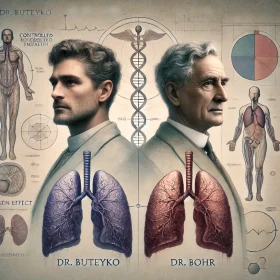
How Buteyko Breathing Works — The Bohr Effect Mechanism Explained
The Question Buteyko Answered
In the 1950s, Konstantin Buteyko — a Ukrainian physician working in Moscow — observed something that contradicted medical intuition: patients with chronic respiratory conditions who were breathing more were getting worse, not better. Asthmatics who took deep breaths during attacks felt temporary relief but progressively worsened over time. People with anxiety who breathed rapidly to "get more air" remained hypoxic despite normal blood oxygen levels.
Buteyko realised the problem was not insufficient oxygen intake but excessive CO2 loss. His method — reducing breathing volume, slowing breathing rate, and emphasising nasal breathing — was designed to restore CO2 to normal levels. What he was doing, whether he framed it this way or not, was leveraging the Bohr Effect.
I covered the Bohr Effect in detail in an earlier post — the core mechanism is that higher tissue CO2 causes haemoglobin to release oxygen more readily. When CO2 is chronically low from overbreathing, haemoglobin holds onto oxygen more tightly, even as it circulates through tissues that need it. This is the physiological basis for why breathing less can deliver more oxygen. Buteyko's method is the practical application of that principle.
What Buteyko Actually Prescribes
The Buteyko method is not a single technique but a framework built around reducing chronic hyperventilation. The core components are:
- Nasal breathing at all times — including during sleep and exercise. The nose creates resistance that naturally slows breathing and maintains higher CO2 levels.
- Reduced tidal volume — breathing less air per breath, which feels counterintuitive but is the direct intervention against hyperventilation.
- Breath holds and control pauses — used both as a measurement (the Control Pause, covered in the Buteyko post) and as a training tool to increase CO2 tolerance.
- Elimination of mouth breathing, sighing, yawning — all of which expel CO2 unnecessarily and reinforce hyperventilation patterns.
The goal is not to hold your breath for long periods or to restrict oxygen. The goal is to retrain the chemoreceptors in the brainstem that have recalibrated to a low-CO2 baseline. Over weeks of practice, the body becomes comfortable with higher CO2 levels — which, through the Bohr Effect, means better oxygen delivery and reduced symptoms.
Why It Works for Chronic Conditions
The conditions Buteyko was originally addressing — asthma, bronchitis, emphysema — are all worsened by chronic hyperventilation. But the mechanism extends beyond respiratory disease. Any condition where tissue oxygenation is compromised, or where the nervous system is chronically activated, benefits from restoring CO2 balance.
For me, managing Ankylosing Spondylitis without constant medication since 2015, Buteyko principles were foundational. Chronic pain keeps the nervous system in sustained activation, which drives faster breathing. Faster breathing lowers CO2. Lower CO2 impairs oxygen delivery to inflamed tissues and perpetuates the stress-inflammation feedback loop. Breaking that cycle required addressing the breathing pattern directly, and Buteyko gave me the framework to do it.
The conditions where Buteyko-based approaches are most relevant include:
- Asthma and other obstructive airway diseases
- Anxiety and panic disorder (where hyperventilation is often the primary mechanism)
- Chronic fatigue and fibromyalgia (where tissue hypoxia despite normal blood oxygen is common)
- Sleep apnoea (particularly where habitual mouth breathing is a factor)
- Autoimmune and inflammatory conditions (where nervous system regulation affects disease activity)
The Practical Challenge
The difficulty with Buteyko is not intellectual — the mechanism is straightforward. The difficulty is compliance. Reducing breathing volume feels wrong. The air hunger sensation that arises when you first slow your breathing is intense, and the instinct is to override it. Most people quit within the first week because the discomfort feels like a signal that something is going wrong, when in fact it is a signal that the chemoreceptors are recalibrating.
This is why structured guidance matters. Buteyko is not a technique you read about and self-implement successfully in most cases. It requires someone checking your baseline, monitoring your progress, and adjusting the approach when you hit resistance. The principles are simple but the execution is not.
Buteyko and Formula.life
Formula.life incorporates Buteyko principles but is not identical to classical Buteyko training. The emphasis on nasal breathing, CO2 tolerance, and reduced breathing volume is the same. But Formula.life also integrates other techniques — coherent breathing for HRV, extended exhalation for vagal activation, and breath patterns tailored to specific nervous system states rather than a one-size protocol.
The goal is the same: shift the autonomic baseline, restore CO2 balance, improve oxygen delivery, reduce chronic activation. Buteyko is one of the clearest frameworks for achieving that, and understanding the Bohr Effect is what makes the framework legible rather than mystical.
Where to Start
If you are dealing with chronic overbreathing, anxiety, or a condition where tissue oxygenation is compromised despite normal blood oxygen, understanding the Bohr Effect and applying Buteyko principles is one of the most direct interventions available. The assessment gives me a baseline picture of your breathing patterns and nervous system state before we work together. And individual sessions are where I apply these principles to your specific condition rather than giving generic advice.
The Bohr Effect explains why Buteyko works. Buteyko provides the how. Together, they form one of the most scientifically grounded approaches to breathwork available.
Next step
Want to work through your situation personally?
Disclaimer: personal experience & self-regulation practices. Not medical advice.