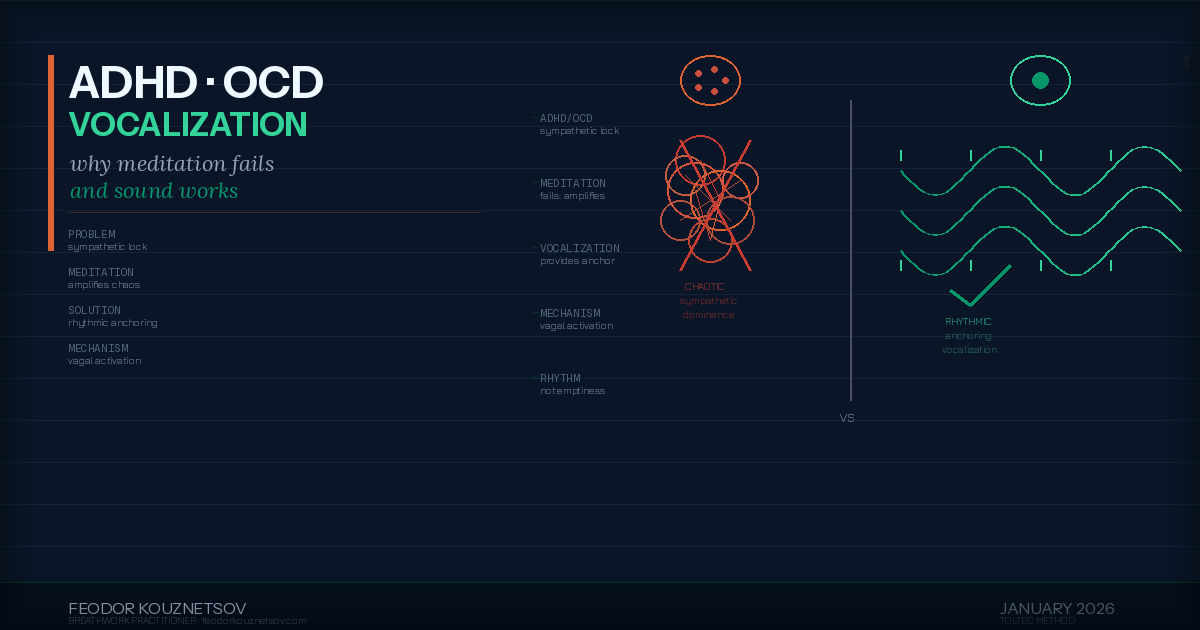
ADHD, OCD, and Breathing Dysfunction — Why Chronic Sympathetic Dominance Makes Meditation Fail and How Vocalization Provides Anchoring
ADHD, OCD, and Chronic Nervous System Activation
ADHD and OCD are typically discussed in terms of behavior — impulsivity, focus problems, intrusive thoughts, compulsive rituals. But underlying these behavioral patterns is a nervous system in chronic sympathetic dominance. The body operates as if under constant low-grade threat, which creates the conditions where focus, impulse control, and thought regulation become difficult.
This is not a cognitive problem that can be solved with willpower or cognitive reframing. It is a physiological state where the autonomic nervous system is chronically biased toward activation. Breathing patterns reflect this: people with ADHD and OCD often hyperventilate unconsciously, maintain chronic chest tension, and have reduced CO2 tolerance, all of which perpetuate sympathetic dominance.
Traditional approaches to calming the nervous system — meditation, mindfulness, guided relaxation — often fail for people with ADHD and OCD because they require sustained passive attention, which these nervous systems cannot maintain. The instruction to "sit still and observe your breath" creates more internal noise, not less.
Why Traditional Meditation Fails for ADHD and OCD
Meditation typically requires you to reduce external stimulation and turn attention inward. For a nervous system that is already hypervigilant and scanning for threats, this creates a problem. When external input decreases, internal noise amplifies. Intrusive thoughts become louder. The mind races faster. The body's restlessness intensifies.
This is predictable. The ADHD/OCD nervous system is not dysregulated because of too much external stimulation — it is dysregulated because the internal arousal system is overactive. Removing external anchors does not calm the system. It removes the only distractions that were preventing full awareness of the internal chaos.
The instruction to "empty the mind" or "let thoughts pass" assumes the mind is capable of disengaging from thought loops. But in OCD, thought loops are compulsive — they are driven by underlying anxiety that the nervous system interprets as a threat signal. Trying to ignore them increases anxiety, which strengthens the compulsion to engage with the thoughts.
In ADHD, sustained attention on a single object (like breath) is difficult not because of lack of discipline but because the nervous system is wired for novelty-seeking and rapid task-switching as a compensatory mechanism for chronic understimulation. Forcing sustained focus on a boring stimulus (watching the breath) creates restlessness and frustration, not calm.
What These Nervous Systems Need: Anchoring, Not Emptiness
The solution is not to remove stimulation but to provide structured, engaging stimulation that occupies the nervous system in a way that produces regulation rather than activation. This is where breathwork with vocalization becomes effective.
Vocalization — humming, toning, sustained vowel sounds, rhythmic breath with sound — provides several things traditional meditation does not:
- Sensory anchoring: The vibration of sound in the chest, throat, and head provides tangible feedback that holds attention without requiring abstract focus
- Vagal activation: Humming and vocalization stimulate mechanoreceptors in the vocal tract and nasal passages that activate vagal afferents, shifting the nervous system toward parasympathetic dominance
- Respiratory pacing: Sustained vocalization requires extended exhalation, which naturally slows breathing rate and increases CO2, both of which reduce sympathetic activation
- Rhythmic structure: Sound provides a repeating pattern that the ADHD/OCD brain can follow without getting bored, unlike passive observation of breath
This is not distraction. It is redirection. The nervous system gets the engagement it needs, but in a form that produces regulation rather than further activation.
Mechanisms: Why Vocalization Works
Vagal Activation via Mechanoreceptors
When you hum or produce sustained vocal tones, the vibration stimulates mechanoreceptors in the larynx, pharynx, and nasal passages. These receptors send signals via the vagus nerve to the brainstem, which increases parasympathetic output. This is measurable — HRV increases during humming, heart rate decreases, and subjective anxiety reduces.
This mechanism is covered in the breathwork physiology post, but it is particularly relevant for ADHD/OCD because these populations have reduced baseline vagal tone. Vocalization provides a direct intervention that strengthens vagal output without requiring the sustained passive attention that meditation demands.
Extended Exhalation and CO2 Normalization
Sustained vocalization requires long exhalations. This naturally slows breathing rate and prevents hyperventilation. People with ADHD and OCD often hyperventilate chronically, which reduces CO2 and increases anxiety (covered in the OCD thought loops post).
When exhalation is extended through vocalization, CO2 levels normalize. This reduces the air hunger sensation that drives rapid breathing, decreases baseline anxiety, and allows the nervous system to shift out of chronic sympathetic activation.
Attention Coupling: Why Rhythm Works Where Observation Fails
The ADHD brain struggles with sustained attention on static stimuli but excels at pattern recognition and rhythmic engagement. Vocalization provides a repeating rhythmic structure — inhale, exhale on sound, repeat. This is engaging enough to hold attention but simple enough to not create cognitive overload.
For OCD, the rhythmic structure provides an alternative to compulsive thought loops. Instead of trying to suppress intrusive thoughts (which amplifies them), the practice gives the mind a structured task that occupies the same cognitive resources the thought loops were using. The thoughts lose strength not because they are ignored but because attention is redirected to a rhythmic sensory task.
Structured Practice Systems: Toltec Methodology as Example
Different breathwork traditions use vocalization in different ways. Buteyko uses breath holds and reduced breathing to increase CO2 tolerance. Pranayama uses breath retention and alternate nostril breathing to regulate energy. Toltec breathwork traditions use sustained vocalization, rhythmic breath-sound patterns, and somatic release to address chronic nervous system activation.
I work primarily within a Toltec-derived methodology because it was designed specifically for people whose nervous systems are chronically activated and who cannot access calm through stillness alone. The practice sequences move through phases: preparation (postural alignment, breath awareness), rhythmic engagement (breath-sound patterns), somatic discharge (allowing tremoring, emotional release), and integration (returning to stillness after activation has been processed).
This is not mystical. It is a structured protocol that uses vocalization, rhythm, and somatic awareness to shift autonomic state. The Toltec framing provides the cultural and philosophical context for the practice, but the mechanisms are physiological: vagal activation, CO2 regulation, rhythmic nervous system pacing, and somatic processing of held activation.
The advantage for ADHD/OCD populations is that the practice is engaging, structured, and produces tangible effects quickly. You do not need to "believe" in anything or achieve a particular mental state. You follow the protocol, and the nervous system responds predictably.
Why Daily Practice Matters
ADHD and OCD nervous systems do not shift permanently from a single intervention. Chronic sympathetic dominance is a baseline state that reasserts itself unless consistently interrupted. Daily practice is not about achieving enlightenment or perfect calm. It is about providing the nervous system with repeated input that gradually shifts baseline autonomic tone.
This is the same principle behind any nervous system retraining — whether Buteyko for CO2 tolerance, coherent breathing for HRV, or vagal toning exercises. The nervous system adapts to repeated patterns. If the pattern is chronic activation, it reinforces activation. If the pattern is daily regulatory input (vocalization, extended exhalation, rhythmic practice), it gradually shifts toward regulation.
The challenge for ADHD populations is maintaining consistency. This is why structured programs with clear protocols work better than self-directed exploration. When the practice is the same every day, there is no decision fatigue about what to do. You show up, follow the sequence, get the effect, and move on.
Perfect Balance: The Program
I teach this methodology in a structured program called Perfect Balance, which was designed specifically for people with ADHD and OCD. The program provides:
- Video-guided sequences that you can follow without having to remember instructions
- Progressive phases that build from basic breath awareness to more complex vocalization and rhythmic patterns
- Short sessions (10-20 minutes) that fit into daily routines without requiring long time commitments
- Somatic processing techniques for releasing chronic tension and stored activation
The program is available as a self-paced online training at feodorbreathing.tech and also on Udemy. If you prefer live work or in-person sessions, I also teach at BreathLab in Brighton.
Purchasing directly through my website allows me to provide better support than platform-mediated courses typically allow, and more of the revenue supports the continued development of this work.
Is Breathwork Sufficient?
No. Breathwork is not a replacement for medication, therapy, or psychiatric care where these are needed. ADHD and OCD have neurobiological components that breathwork does not address directly. But as a daily tool for nervous system regulation, breathwork with vocalization provides something that medication and therapy often do not: direct, immediate autonomic regulation that you can access any time activation becomes overwhelming.
When combined with other treatments, breathwork improves outcomes. Therapy is more effective when the nervous system is regulated enough to engage with therapeutic processes. Medication works better when baseline autonomic dysregulation is addressed. Sleep improves, which supports cognitive function and emotional regulation. Relationships improve because you are less reactive and more present.
This is not about replacing medical care. It is about adding a tool that addresses the autonomic dysregulation underlying many of the symptoms that medication and therapy are also targeting.
When Individual Guidance Helps
For people who have tried multiple breathwork approaches without success, individual work helps identify which specific patterns are maintaining sympathetic dominance and which techniques are most effective for your particular nervous system. The assessment identifies breathing pattern dysfunction, autonomic state, and specific triggers. And in individual sessions, I guide the practice with real-time adjustments based on your response.
ADHD and OCD are not the same condition, and the breathwork approach needs to be tailored accordingly. ADHD benefits from rhythmic, engaging practices that provide structure without boredom. OCD benefits from practices that redirect attention away from thought loops without creating new compulsions. Both benefit from vagal activation and CO2 normalization, but the specific techniques and sequences differ.
Vocalization is not a cure for ADHD or OCD. It is a tool for regulating the chronic nervous system activation that makes these conditions more difficult to manage. When the nervous system is less activated, everything else — focus, impulse control, thought regulation, sleep, relationships — becomes easier. This is physiology, not philosophy.
Next step
Want to work through your situation personally?
Disclaimer: personal experience & self-regulation practices. Not medical advice.