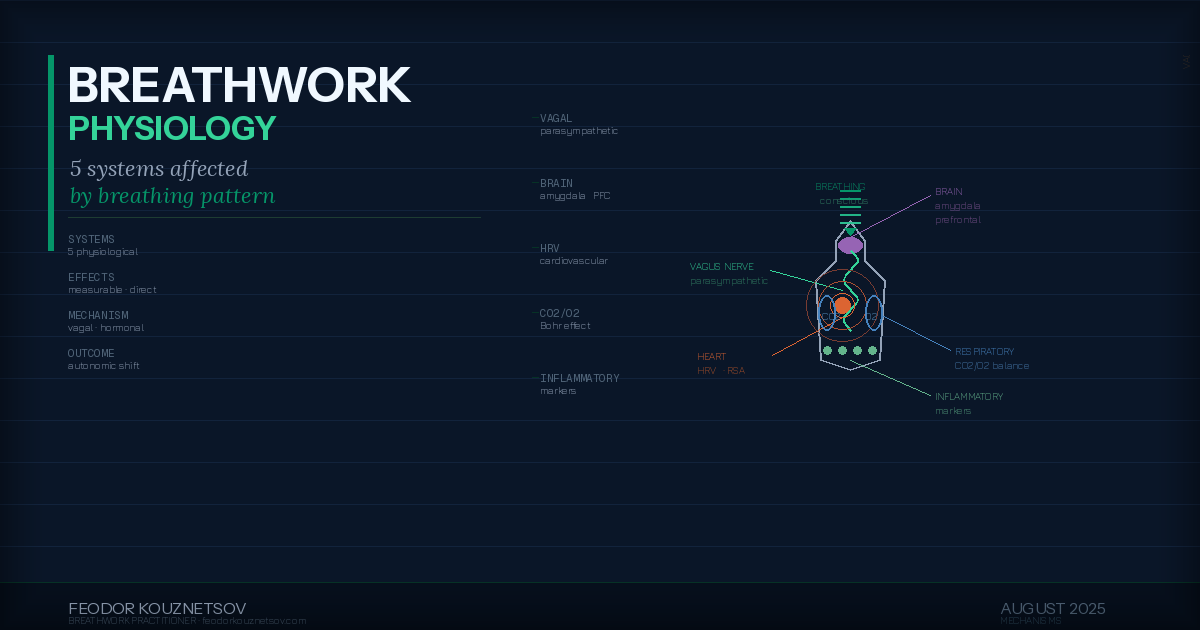
The Physiology of Breathwork — How Breathing Pattern Affects Nervous System, Brain, and Cardiovascular Function
What Breathwork Actually Changes
Breathwork is the deliberate manipulation of breathing pattern — rate, depth, rhythm, and pathway (nasal vs. oral) — to produce specific physiological effects. This is not metaphorical. Changing how you breathe produces measurable changes in autonomic nervous system activity, brain function, cardiovascular regulation, and inflammatory markers.
The mechanisms are well-documented. What follows is an overview of the primary physiological systems affected by conscious breathing and the evidence supporting these effects.
1. Autonomic Nervous System: Vagal Activation
The autonomic nervous system has two primary branches: sympathetic (arousal, stress response) and parasympathetic (rest, recovery). These are not simply on/off switches. They operate on a continuum, and their balance determines baseline physiological state.
Breathing is unique among autonomic functions because it is both automatic and voluntary. You breathe without conscious effort, but you can also take control of the pattern at will. This dual nature makes breath the most accessible entry point for autonomic regulation.
The Vagus Nerve Connection
The vagus nerve is the primary pathway of the parasympathetic nervous system. It originates in the brainstem and extends to the heart, lungs, and digestive organs. Vagal tone — the strength of vagal nerve activity — determines how quickly you can shift from sympathetic arousal to parasympathetic calm.
Breathing rate and pattern directly affect vagal activity. Slow breathing, particularly with extended exhalation, activates vagal efferent fibres that reduce heart rate, lower blood pressure, and signal the brainstem to shift toward parasympathetic dominance. This is not a relaxation response in the subjective sense — it is a measurable physiological shift.
The mechanism is straightforward: stretch receptors in the lungs detect changes in lung volume. Slow, deep breathing with extended exhalation activates these receptors, which send signals via the vagus nerve to the brainstem. The result is increased parasympathetic output and reduced sympathetic tone.
This is why extended exhalation breathing (covered in the daily integration post) is effective for reducing acute stress and facilitating the shift into parasympathetic states.
2. Brain Function: Amygdala Activity and Prefrontal Cortex Engagement
Chronic stress and rapid shallow breathing are associated with increased amygdala activity — the brain region involved in threat detection and fear response. When the amygdala is chronically activated, the nervous system remains in a state of heightened vigilance, which perpetuates anxiety, reduces cognitive flexibility, and impairs decision-making.
Slow breathing shifts activation away from the amygdala and toward the prefrontal cortex, the brain region responsible for executive function, emotional regulation, and long-term planning. This is not just a correlation. Studies using fMRI have shown that controlled slow breathing reduces amygdala reactivity and increases prefrontal cortex engagement in response to stressful stimuli.
The mechanism likely involves both direct autonomic effects (vagal activation reducing sympathetic arousal) and indirect effects through CO2 and oxygen balance. When breathing slows, CO2 levels stabilize, which reduces the respiratory drive that contributes to anxiety and panic.
This shift in brain activity has practical consequences: improved emotional regulation, better cognitive performance under stress, and reduced reactivity to triggers. These are not subjective improvements — they are measurable changes in brain function.
3. Respiratory Chemistry: The CO2-Oxygen Balance
Oxygen delivery to tissues is not determined solely by how much oxygen you inhale. It is determined by the balance between oxygen and carbon dioxide in the blood. This is the Bohr Effect, covered in detail in the Bohr Effect post.
In brief: hemoglobin binds oxygen in the lungs and releases it in the tissues. The release of oxygen from hemoglobin is facilitated by the presence of CO2. When CO2 levels are too low — as happens with chronic hyperventilation or rapid breathing — hemoglobin holds onto oxygen more tightly, and tissues receive less oxygen despite adequate oxygen saturation in the blood.
This is why people who hyperventilate often report symptoms of hypoxia (dizziness, brain fog, cold extremities) even though their blood oxygen levels are normal. The problem is not oxygen intake — it is oxygen delivery, which is impaired by low CO2.
Slow nasal breathing maintains higher CO2 levels, which improves oxygen delivery to tissues. This is one of the core mechanisms behind Buteyko breathing and why nasal breathing (covered in the mouth breathing post) is emphasized in most breathwork traditions.
4. Cardiovascular Function: Heart Rate Variability and Respiratory Sinus Arrhythmia
Heart rate is not constant. It varies from beat to beat in response to breathing, autonomic tone, and metabolic demands. This variation is called heart rate variability (HRV), and it is one of the most robust markers of autonomic function and stress resilience.
Higher HRV indicates greater autonomic flexibility — the ability to shift between sympathetic and parasympathetic states as needed. Lower HRV indicates chronic sympathetic dominance and reduced capacity for stress recovery.
Respiratory Sinus Arrhythmia
There is a natural coupling between breathing and heart rate called respiratory sinus arrhythmia (RSA). During inhalation, heart rate increases slightly. During exhalation, it decreases. This is a healthy, adaptive response mediated by vagal activity.
When you breathe slowly and rhythmically — particularly at a rate around 5-6 breaths per minute — RSA becomes more pronounced, and HRV increases. This breathing rate maximizes the synchronization between breath and heart rate, which strengthens vagal tone and improves cardiovascular regulation.
This is the mechanism behind coherent breathing, covered in the coherent breathing post. Practicing coherent breathing regularly increases baseline HRV, which translates to better stress resilience, faster recovery from activation, and improved cardiovascular health.
5. Inflammatory Response: The Wim Hof Study and Its Implications
There is evidence that certain breathwork practices can influence immune function and inflammatory response. The most cited study is the 2014 research involving Wim Hof and trained volunteers who practiced a combination of hyperventilation, breath retention, and cold exposure.
When these trained individuals were injected with bacterial endotoxin (which normally triggers an immune response with flu-like symptoms), they showed reduced inflammatory markers, increased adrenaline levels, and fewer symptoms compared to the control group.
This was significant because it suggested that voluntary interventions (breathwork and cold exposure) could modulate the innate immune response, which was previously thought to be entirely involuntary.
Context and Limitations
This study is often cited to support claims that breathwork can "control the immune system." This is an overstatement. The study showed that a specific protocol (hyperventilation + breath holds + cold exposure) could acutely suppress certain inflammatory markers in response to a controlled endotoxin challenge. It did not demonstrate long-term immune regulation, nor did it show effects on chronic inflammatory conditions.
The mechanism is likely through acute sympathetic activation via adrenaline release, which has known anti-inflammatory effects in the short term. This is different from the parasympathetic activation produced by slow breathing, and it is not a protocol suitable for daily practice or for people managing chronic stress or autoimmune conditions.
The takeaway is not "breathwork controls immunity" but rather "acute sympathetic activation through specific breathwork protocols can temporarily suppress certain inflammatory responses under controlled conditions." This is interesting research, but it does not translate directly to therapeutic application for most people.
How These Mechanisms Translate to Practice
Understanding the physiology is useful because it clarifies what breathwork can and cannot do. Breathwork is not a cure-all. It is a set of tools that affect specific physiological systems in predictable ways:
- Extended exhalation breathing activates vagal pathways → reduces sympathetic arousal
- Coherent breathing (5-6 breaths/min) increases HRV → improves stress resilience
- Slow nasal breathing maintains CO2 balance → improves oxygen delivery
- Regular practice shifts baseline nervous system state → reduces chronic sympathetic dominance
These are measurable effects. They happen whether or not you feel calm or relaxed. The subjective experience matters, but the physiological benefit is independent of how you interpret it.
Practical Starting Point: Coherent Breathing
The most accessible and well-researched breathwork practice is coherent breathing, also called resonance frequency breathing. The protocol is simple:
- Inhale through nose: 5 seconds
- Exhale through nose: 5 seconds
- No pause between breaths
- Maintain for 5-20 minutes
This breathing rate (6 breaths per minute) maximizes HRV and strengthens vagal tone. It is not meditation. It is autonomic training. You do not need to clear your mind or feel present. You just need to maintain the rhythm.
Practiced daily, coherent breathing produces cumulative effects: increased baseline HRV, reduced baseline anxiety, improved stress recovery, and better autonomic flexibility.
When Individual Guidance Helps
The physiology is straightforward, but applying it to your specific situation requires understanding your baseline state, identifying which techniques are appropriate for your symptoms, and troubleshooting when the standard protocols do not produce the expected effects.
This is where individual work helps. The assessment gives me your baseline autonomic function, breathing patterns, and symptoms. And in individual sessions, I teach the techniques that address your specific nervous system state and guide the practice so you get the physiological benefit without the common mistakes that undermine effectiveness.
Breathwork is not magic. It is physiology. And when you understand the mechanisms, you can use it as the tool it is — precise, predictable, and effective.
Next step
Want to work through your situation personally?
Disclaimer: personal experience & self-regulation practices. Not medical advice.