Ankylosing Spondylitis and Chronic Holding Patterns — How Nervous System Dysregulation, Emotional Suppression, and Somatic Tension Maintain Inflammation
Beyond Inflammation: The Psychosomatic Dimension
For the first few years after my AS diagnosis in 2012, I treated it as a purely physical disease. Inflammation. Pain. Stiffness. Fatigue. I focused on diet, medication, exercise, and later breathwork as physiological interventions. All of this helped. But over 14 years of living with this condition and 11 years of managing it without constant medication, I have observed a pattern that goes beyond inflammation markers and joint fusion.
Every time I lived in a way that contradicted my actual needs, my body became more rigid. Every time I suppressed emotional responses, maintained chronic internal tension, tried to please everyone while ignoring my own direction, pushed through exhaustion without rest — the body responded. Specifically: the spine, the gut, the nervous system.
This is not metaphor. It is observable cause and effect. And while I cannot claim that psychological patterns cause AS — the disease has genetic, immunological, and environmental components — I am convinced that chronic nervous system dysregulation and somatic holding patterns play a significantly larger role in symptom severity and disease progression than conventional treatment models acknowledge.
Nervous System Dysregulation and Chronic Holding
People with AS often live in a state of chronic sympathetic activation. The nervous system remains in protection mode even when no immediate threat exists. This is not anxiety in the psychological sense — it is a physiological state where the autonomic nervous system cannot fully shift into parasympathetic dominance (rest, digest, repair).
This creates predictable somatic patterns:
- Shallow breathing: Diaphragm remains chronically tense, preventing full descent during inhalation
- Abdominal bracing: Core muscles maintain low-grade contraction, restricting gut motility and diaphragmatic function
- Pelvic floor tension: Chronic holding in pelvic floor muscles, often unconscious, which affects digestion, sexual function, and lower back stability
- Jaw clenching: Temporomandibular tension, especially during sleep, which signals ongoing nervous system activation
- Vocal restriction: Voice becomes smaller, tighter, less resonant — covered in the voice production post
These are not random symptoms. They are coherent expressions of a nervous system stuck in a defensive state. And because the nervous system and immune system are bidirectionally connected — chronic sympathetic activation increases inflammatory cytokine production, which worsens AS symptoms, which increases pain and stress, which maintains sympathetic activation — the loop reinforces itself.
Family Patterns and Embodiment
I have observed that many men with AS (myself included) experienced family dynamics where masculine and feminine energies were inverted or unstable. In my case: my mother carried strong masculine energy (directive, controlling, protective), while my father was passive and withdrawn. This created an environment where I existed "between" poles — not fully grounded in my own embodied presence.
I am not using "masculine" in the performative sense (aggression, dominance, control). I mean it in the embodied, nervous system sense:
- Clarity: Ability to know what I need and act on it without chronic self-doubt
- Stability: Capacity to remain present under stress without collapsing or fragmenting
- Direction: Internal sense of forward movement rather than chronic stuckness or reactivity
- Presence: Occupying my body fully rather than dissociating or living primarily in my head
- Voice: Ability to speak clearly and resonate vocally without constriction
- Digestion: Both literal (gut function) and metaphorical (processing life experience without chronic overwhelm)
When these capacities are underdeveloped or disrupted — often due to early attachment patterns, family dynamics, or chronic stress — the body adapts by creating compensatory holding patterns. The nervous system remains in protection mode because it never learned to fully relax into safety.
This is covered in depth in the attachment patterns post, but the specific relevance to AS is this: chronic holding creates chronic inflammation. The body cannot repair itself effectively when the nervous system is locked in defense.
The Gut-Spine-Nervous System Connection
Digestion is not just stomach acid and enzymes. It is a nervous system function. The enteric nervous system (gut) and autonomic nervous system (regulation) are intimately connected via the vagus nerve. When the nervous system is in chronic sympathetic activation, gut motility slows, gut permeability increases, and the inflammatory response in the gut intensifies.
For people with AS, this matters because:
- Many AS patients have subclinical or diagnosed inflammatory bowel conditions (Crohn's, ulcerative colitis, IBS)
- Gut inflammation drives systemic inflammation, which worsens joint symptoms
- Chronic abdominal tension restricts diaphragmatic breathing, which perpetuates sympathetic activation
- Poor vagal tone (the nerve connecting brain, gut, and immune system) reduces the body's ability to downregulate inflammation
I have observed over years of working with my own body and with clients: when diaphragmatic tension releases, when pelvic floor holding softens, when breathing deepens and slows — digestion improves. Not because of a supplement or diet change, but because the nervous system shifted states.
Somatic Holding in Men: The Pelvic-Abdominal Pattern
Many men with chronic health conditions (AS, chronic pain, autoimmune disease, digestive issues) hold significant tension in the pelvis and lower abdomen. This is often unconscious — they do not feel it until specific breathwork or bodywork brings awareness to the area.
The pattern typically includes:
- Chronic pelvic floor contraction (muscles that support bladder, bowel, sexual function)
- Abdominal bracing (core muscles held tight as if preparing for impact)
- Shallow breathing (diaphragm restricted by abdominal tension)
- Reduced genital sensation and sexual function (blood flow and nerve function compromised by chronic tension)
- Lower back rigidity (compensation for lack of pelvic mobility)
This pattern develops for reasons: early shame or fear around sexuality, chronic stress requiring the body to "armor" vulnerable areas, postural compensation for spinal issues, or simply years of living in sympathetic dominance where the body never fully relaxes.
Releasing this pattern requires more than stretching or relaxation. It requires nervous system retraining — teaching the body that it is safe to soften, to breathe into the pelvis, to allow movement and sensation in areas that have been chronically guarded.
Breath, Sound, and Somatic Release
The breathwork practices I developed for myself (and now teach) are not generic relaxation techniques. They are designed specifically to address chronic holding patterns in the diaphragm, pelvis, jaw, and throat — the areas where nervous system tension manifests most persistently in AS and other chronic conditions.
The approach combines:
- Nasal breathing: Activates parasympathetic pathways, increases CO2 tolerance, reduces hyperventilation-driven inflammation (covered in the mouth breathing post)
- Vocalization (humming, toning): Stimulates vagal afferents in the throat and nasal passages, releases jaw and throat tension, provides direct feedback on nervous system state through vocal quality
- Diaphragmatic awareness: Deliberate focus on allowing the diaphragm to descend fully during inhalation, which requires releasing abdominal bracing
- Pelvic breathing: Directing breath awareness into the pelvis, allowing expansion and softening in pelvic floor and lower abdomen
- Extended exhalation: Long, slow exhalations activate vagal efferents, shifting the nervous system from sympathetic to parasympathetic dominance
- Sound resonance: Using sustained vocal tones to create vibration in the chest, throat, and head — the vibration itself releases chronic muscular holding and provides biofeedback about tension patterns
When these elements work together — breath, sound, vibration, attention, and body awareness — the nervous system begins to shift. Not through force or willpower, but through consistent input that signals safety and allows the body to release patterns it has been holding for years.
Observable Changes
Over 11 years of working with these practices, I have observed specific changes that correlate with consistent practice:
- Digestion improves: Gut motility increases, bloating decreases, food tolerance expands
- Nervous system calms: Baseline anxiety reduces, sleep quality improves, stress recovery is faster
- Voice changes: Vocal quality becomes fuller, resonance increases, throat constriction decreases
- Body feels safer: Chronic hypervigilance reduces, ability to relax deepens, presence in the body strengthens
- Spine responds differently: Morning stiffness duration decreases, pain intensity reduces, mobility improves
- Internal pressure releases: The sensation of chronic inner tension that many AS patients describe begins to soften
These are not universal outcomes. They are patterns I have observed in myself and in men I have worked with who have similar chronic holding patterns. The mechanisms are physiological — vagal activation, CO2 normalization, somatic release, nervous system retraining — but the subjective experience is relief.
This Is Not a Cure
I am not claiming that breathwork or voice work cures ankylosing spondylitis. AS is a complex autoimmune disease involving genetics, inflammation, immune dysregulation, environmental triggers, and factors we do not yet fully understand.
But I am asserting, based on 14 years of living with this condition and 11 years of managing it without constant medication, that chronic internal tension, emotional suppression, stress dysregulation, and somatic holding patterns play a significantly larger role in symptom severity and disease progression than conventional medical models account for.
The body is not separate from how a person lives internally. When someone chronically suppresses emotions, lives against their actual needs, maintains constant inner tension, ignores gut signals, and operates from a nervous system stuck in protection mode — the body responds. For people with AS, that response includes increased inflammation, increased pain, increased rigidity, and accelerated disease progression.
Addressing these patterns does not replace medical treatment. It complements it. Anti-inflammatory medication, biologics, physical therapy, and medical monitoring remain essential for many people with AS. But without addressing the nervous system and somatic dimension, treatment often manages symptoms without addressing the underlying dysregulation maintaining them.
When Individual Work Is Needed
Generic breathwork protocols can help with baseline regulation. The systematic AS breathing protocol provides structure for daily practice. But when chronic holding patterns are deeply embedded — when pelvic tension is persistent, when abdominal bracing is unconscious, when voice remains constricted despite technique practice, when the nervous system cannot shift out of protection mode even with correct breathing — individual work is needed.
Over the past 10 years, I have studied how breathing, voice, and vibration shape a man's state. Not as abstract concepts, but as observable physiological processes that directly affect energy levels, nervous system function, male health, digestion, presence, and the relationship a man has with his own body.
I no longer create generic practices. There are no universal protocols that work for everyone. There are only practices that fit a specific person at a specific moment in their life — built around their current state, their specific holding patterns, their nervous system function, their voice quality, their actual needs.
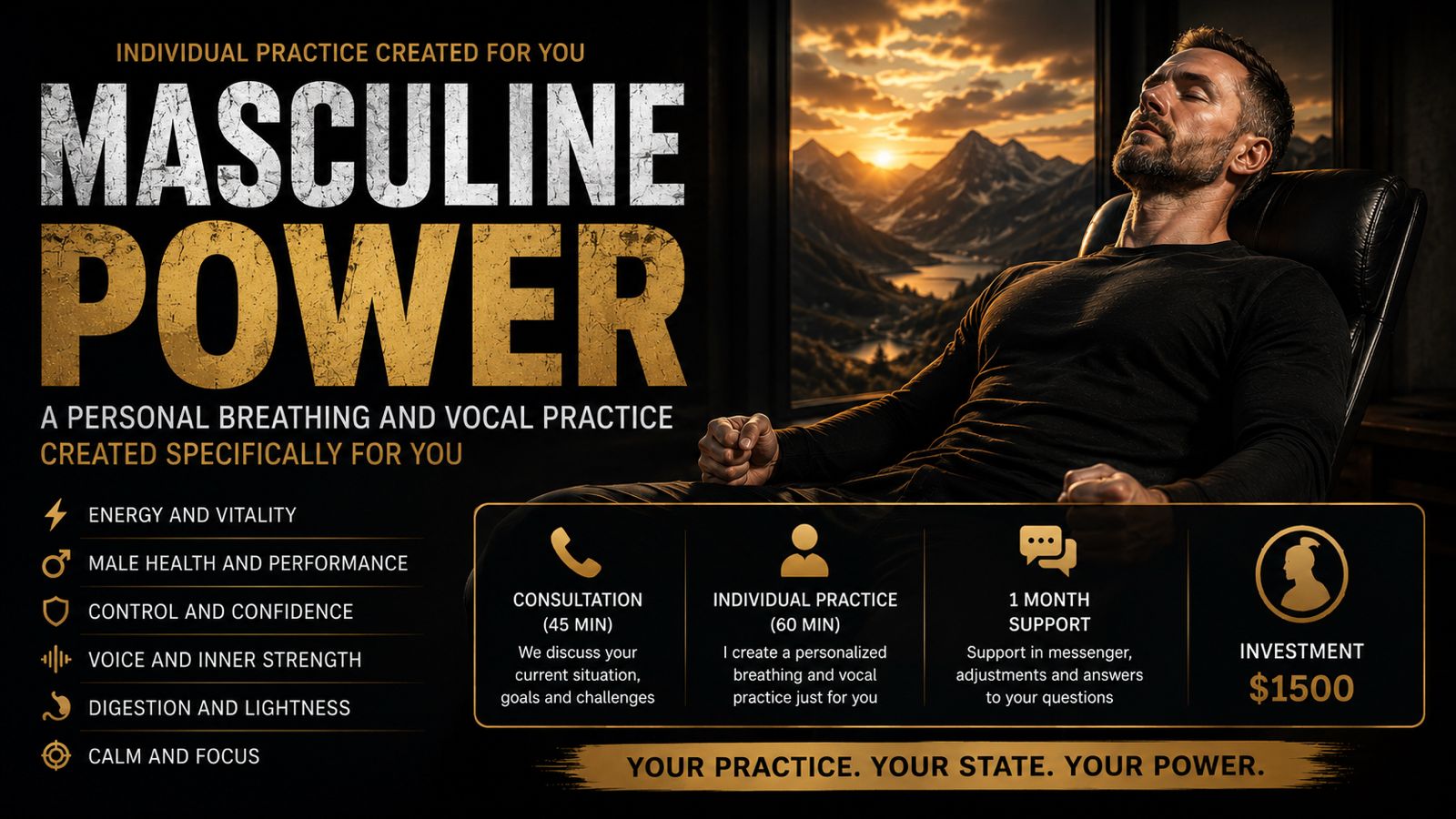
This is what I create in the Masculine Power practice: a personal breathing and vocal protocol built specifically for you, based on a detailed conversation about your life, your state, and your goals. Not a course. Not a template. A practice designed for your body, your nervous system, your patterns.
If you recognize these chronic holding patterns in yourself — the pelvic tension, the abdominal bracing, the constricted voice, the nervous system that cannot fully relax, the gut that does not work properly, the sense of being disconnected from your own body — this work addresses those patterns directly. Not through generic techniques, but through a practice built for you.
Next step
Want to work through your situation personally?
Disclaimer: personal experience & self-regulation practices. Not medical advice.