Why Correcting Mouth Breathing Affects More Than Just Breathing — Cascading Effects on Sleep, Stress, and Daily Function
Why One Pattern Affects So Much
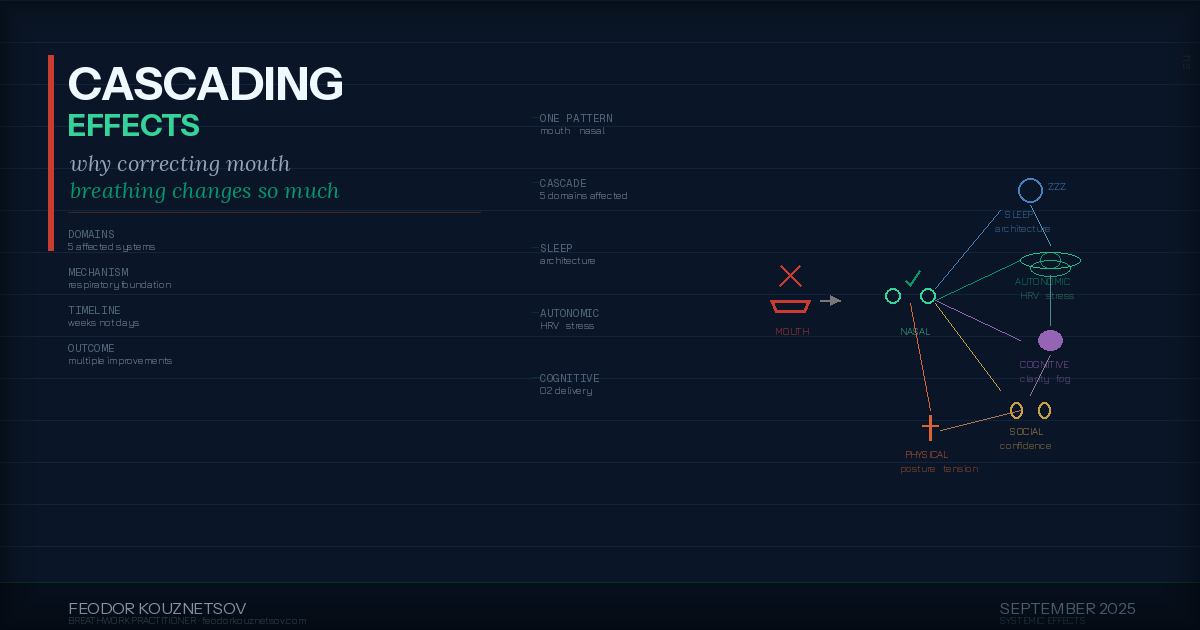
When you correct chronic mouth breathing, people often report improvements that seem unrelated to breathing itself: better sleep, reduced anxiety, improved focus, fewer social embarrassments, even changes in facial tension and posture. This is not placebo. It is the result of correcting a foundational pattern that affects multiple downstream systems.
Mouth breathing is not an isolated habit. It sits at the intersection of respiratory chemistry, autonomic function, sleep architecture, and even social behavior. When you fix it, the effects cascade through systems that depend on proper respiratory function. This post covers the major domains affected and the mechanisms behind each effect.
Sleep Quality: Architecture and Fragmentation
The most immediate and dramatic effect of correcting mouth breathing is improved sleep quality. Chronic mouth breathing during sleep is strongly associated with sleep fragmentation, snoring, and obstructive sleep apnea.
The Mechanism
When the mouth is open during sleep, the tongue falls backward, partially obstructing the airway. This creates turbulent airflow (snoring) and intermittent hypoxia (oxygen desaturation) that fragments sleep architecture. Even without diagnosed sleep apnea, mouth breathing reduces time spent in deep slow-wave sleep and REM sleep — the stages where nervous system recovery and memory consolidation occur.
When you correct mouth breathing and establish consistent nasal breathing during sleep (often with the aid of mouth taping, covered in the mouth breathing correction post), the tongue rests in its proper position against the palate, the airway remains open, and sleep architecture normalizes.
The result: people wake feeling rested rather than exhausted, morning headaches disappear, and daytime energy improves without changing total sleep duration. The quality of sleep changes, not just the quantity.
Autonomic Regulation: Breaking the Sympathetic Loop
Chronic hyperventilation through the mouth maintains the nervous system in sympathetic dominance. As covered in the breathwork physiology post, rapid shallow breathing reduces CO2, which increases baseline anxiety, reduces HRV, and keeps the nervous system in a state of chronic low-grade stress.
The Cascade
When you correct mouth breathing and establish slow nasal breathing, several things happen:
- CO2 levels normalize, which reduces the respiratory drive that contributes to anxiety
- Nasal breathing activates vagal pathways that shift the nervous system toward parasympathetic dominance
- HRV increases, indicating improved autonomic flexibility and stress resilience
- Baseline cortisol decreases as the body no longer interprets rapid breathing as a threat signal
This is why people report feeling less anxious after correcting mouth breathing even though they were not consciously aware of being anxious before. The nervous system was chronically activated, and correcting the breathing pattern removed the physiological driver of that activation.
Cognitive Function: Oxygenation and Mental Clarity
Chronic mouth breathing impairs oxygen delivery to the brain despite normal blood oxygen saturation. The mechanism is the Bohr Effect (covered in the Bohr Effect post): low CO2 levels caused by hyperventilation reduce oxygen release from hemoglobin to tissues.
The result is chronic low-grade cerebral hypoxia — brain fog, difficulty concentrating, mental fatigue, and reduced cognitive performance. People often attribute this to poor sleep, stress, or aging, when the actual cause is impaired oxygen delivery due to breathing pattern dysfunction.
What Changes
When nasal breathing is established and CO2 levels normalize, oxygen delivery to the brain improves. People report:
- Sharper thinking and faster information processing
- Improved working memory and ability to hold multiple concepts simultaneously
- Reduced mental fatigue during cognitively demanding tasks
- Better decision-making under stress
This is not a subjective improvement. It is measurable through cognitive performance tests before and after breathing pattern correction.
Social Function: Bad Breath, Dry Mouth, and Confidence
This is rarely discussed in breathwork literature, but it is significant: chronic mouth breathing causes dry mouth, which increases bacterial growth and produces persistent bad breath. It also causes visible mouth dryness, cracked lips, and frequent need to drink water during conversation.
These are not trivial cosmetic issues. They affect social confidence, particularly in close-proximity interactions: romantic relationships, professional meetings, public speaking. People compensate by avoiding closeness, over-using mints or gum, or feeling self-conscious during conversations.
Why It Resolves
Nasal breathing maintains moisture in the oral cavity because saliva production is stimulated by proper oral posture (tongue against palate). When mouth breathing is corrected:
- Saliva production normalizes
- Bacterial overgrowth decreases
- Bad breath resolves without artificial interventions
- Dental health improves (reduced decay and gum disease)
The social confidence that follows is not about "self-esteem work" — it is about removing a legitimate physiological problem that was creating social friction.
Physical Symptoms: Tension, Posture, and Facial Structure
Chronic mouth breathing affects physical structure and postural patterns in ways people do not connect to breathing:
- Forward head posture: Mouth breathers compensate by tilting the head forward to open the airway, which creates chronic neck and upper back tension
- Jaw tension: The jaw hangs open rather than resting in its neutral position, which fatigues the muscles and can contribute to TMJ dysfunction
- Facial development (in children): Chronic mouth breathing alters craniofacial growth, leading to narrow palates, malocclusion, and long face syndrome
In adults, correcting mouth breathing does not reverse structural changes, but it does resolve the muscular tension and postural compensations that maintain chronic pain and fatigue.
The Timeline: What Changes and When
The effects of mouth breathing correction unfold over weeks, not days. Here is the typical progression:
Week 1-2: Acute Improvements
- Sleep quality improves (less snoring, fewer night wakings)
- Morning dry mouth and bad breath reduce
- Initial reduction in daytime anxiety (nervous system begins to shift)
Week 3-4: Autonomic Shift
- HRV increases (measurable on tracking devices)
- Baseline stress and hypervigilance decrease
- Cognitive performance improves (sharper focus, less mental fatigue)
Week 6-8: Stabilization
- Nasal breathing becomes automatic (no longer requires conscious effort)
- Sleep architecture fully normalizes
- Social confidence and physical symptoms (posture, tension) continue to improve
The key is consistency. The nervous system needs repeated input over weeks to shift its baseline. Most people who fail to correct mouth breathing quit within the first two weeks because the initial discomfort (air hunger, adaptation period) stops them before the cascade of benefits begins.
Why This Matters for Chronic Conditions
For people managing chronic conditions — anxiety, autoimmune disease, chronic pain, inflammatory conditions — mouth breathing is often an unrecognized contributing factor. It maintains sympathetic dominance, reduces oxygen delivery, disrupts sleep, and perpetuates low-grade inflammation.
Correcting mouth breathing does not cure these conditions, but it removes a significant driver of symptom persistence. When combined with other interventions (medication, therapy, lifestyle changes), it accelerates improvement and makes other treatments more effective.
How to Work With This
If mouth breathing is a factor in your symptoms, correcting it requires two things: establishing nasal patency (clearing the nasal passages) and retraining the breathing pattern to prefer nasal breathing automatically. The mouth breathing correction post covers the protocol in detail.
For people who want structured guidance through the process, I teach this systematically in a course format that covers the physiology, technique, troubleshooting, and adaptation period. Details are on the courses page, and there is a video introduction explaining the approach.
And for individual work tailored to your specific situation — whether structural nasal issues, chronic congestion, or difficulty tolerating the adaptation period — the assessment gives me your baseline, and individual sessions are where I guide the correction process directly.
Mouth breathing is not a minor habit. It is a foundational pattern that affects sleep, stress, cognition, and social function. Correcting it produces a cascade of improvements because all of these systems depend on proper respiratory function. This is not self-actualization. It is physiology.
Next step
Want to work through your situation personally?
Disclaimer: personal experience & self-regulation practices. Not medical advice.