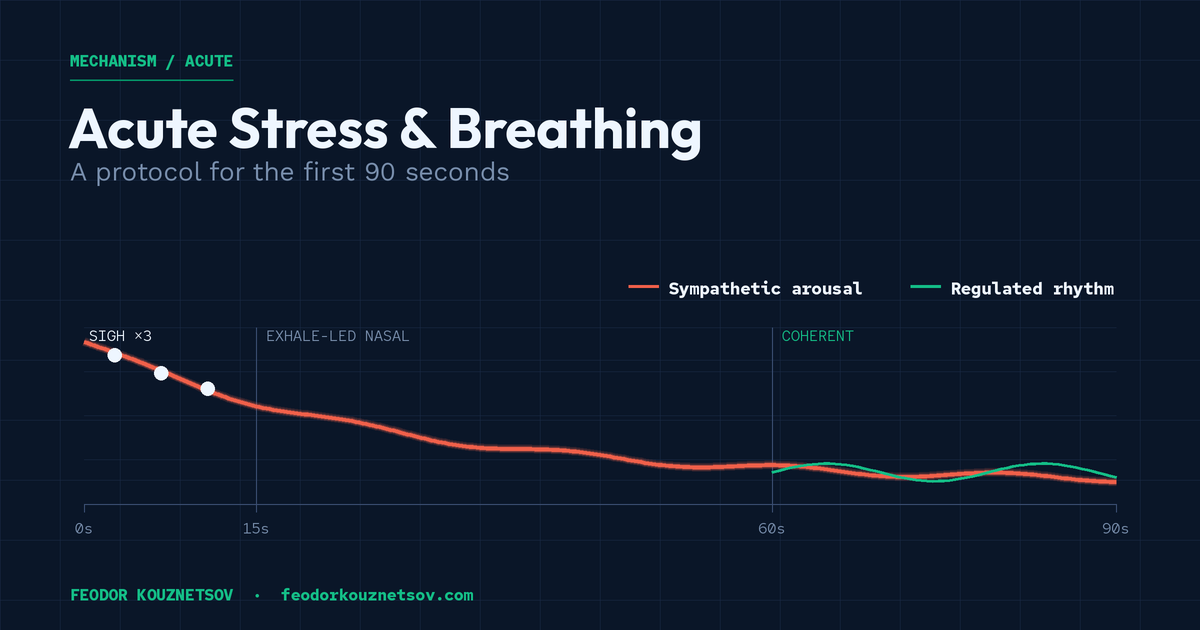
Acute Stress and Breathing — A Protocol for the First 90 Seconds
Acute Stress Is Not Chronic Stress
Almost everything written about breathing and stress is about chronic stress — the sustained, low-grade sympathetic activation that builds over weeks and reshapes your baseline. That is handled with daily practice and gradual retraining. Acute stress is a different event with a different timeline. A confrontation, a near-miss in traffic, a phone call with bad news, the moment before you speak in public: the sympathetic nervous system fires within a second, adrenaline and noradrenaline flood the bloodstream, heart rate and breathing rate jump, and blood shifts toward the large muscles. This is the acute stress response, and it does not respond to a daily practice. It responds to what you do in the next ninety seconds.
The ninety-second figure is a useful anchor. The initial neurochemical surge of a stress response — the catecholamine wave that produces the racing heart and the tunnel-vision feeling — moves through the bloodstream and clears within roughly a minute and a half, provided nothing keeps re-triggering it. The problem is that two things usually do keep re-triggering it: the thoughts you loop on, and the way you are breathing. You cannot always stop the thoughts in the moment. You can change the breathing immediately, and the breathing is the faster lever.
What the Body Is Actually Doing
In an acute surge, breathing becomes fast, shallow, and thoracic — pulled up into the chest and neck. This over-breathing blows off carbon dioxide faster than the body produces it. CO2 falls, blood pH rises (respiratory alkalosis), and that shift produces the classic escalation symptoms: light-headedness, tingling in the hands and face, a sense of unreality, and a pounding heart. Crucially, low CO2 also causes vasoconstriction and, through the Bohr effect, makes haemoglobin hold onto oxygen more tightly — so less oxygen reaches the brain and tissues even though blood oxygen saturation looks fine. I covered this counterintuitive mechanism in the Bohr effect post and its symptom cascade in the post on overbreathing.
The important point is that the breathing does not just reflect the panic — it amplifies it. Fast shallow breathing lowers CO2, low CO2 produces frightening physical sensations, and those sensations feed the sense of threat, which drives faster breathing. Interrupting this is the whole game. You are not trying to feel calm. You are trying to stop the breathing from adding fuel.
The Physiological Sigh
The single most effective in-the-moment tool is the physiological sigh: a double inhale through the nose — a normal inhale followed immediately by a second, shorter sip of air on top of it — followed by a slow, extended exhale, usually through the mouth. It is the pattern the body performs spontaneously when you sob, and during sleep, to reinflate collapsed alveoli.
It works through two mechanisms at once. The second inhale pops open alveoli that shallow breathing has left partially collapsed, which improves gas exchange. The long exhale offloads CO2 in a controlled way rather than a panicked one, and — more importantly — a prolonged exhale engages the baroreflex and stimulates vagal (parasympathetic) output, slowing the heart. Of all the deliberate breathing patterns studied for real-time reduction of arousal, extended-exhale patterns like the physiological sigh act the fastest, because they use the exhale itself as a direct brake on the sympathetic surge.
The 90-Second Protocol
Seconds 0–15: two or three physiological sighs
- Double inhale through the nose — a full breath in, then a second short sip on top.
- Long, slow exhale through the mouth, letting the shoulders drop.
- Repeat two or three times.
Mechanism: reinflates alveoli and delivers an immediate vagal brake through the extended exhale. This is the fastest way to take the edge off the surge.
Seconds 15–60: light, exhale-led nasal breathing
- Close the mouth. Breathe only through the nose.
- Make the exhale about twice the length of the inhale — roughly four seconds in, eight seconds out.
- Keep the breaths small. Do not gulp.
Mechanism: nasal breathing and small breaths let CO2 recover toward normal, which reverses the alkalosis-driven symptoms. The long exhale keeps vagal tone up. The instinct to take huge gulping breaths is the trap — that keeps CO2 low and the symptoms alive.
Seconds 60–90: return to rhythm
Settle into a steady nasal rhythm of roughly six breaths per minute — the coherent breathing pattern — and hold it for the rest of the ninety seconds and beyond if you have time. By now the catecholamine wave is clearing and you are giving the nervous system a stable rhythm to lock onto instead of a chaotic one.
Why "Just Breathe Deeply" Backfires
The common advice to take a big deep breath is often wrong for acute stress. Large, fast breaths — especially through the mouth — blow off even more CO2 and can deepen the light-headedness and tingling, making the episode worse. The effective move is almost the opposite: smaller breaths, nasal, with a long exhale. It is not about volume. It is about slowing the rhythm and lengthening the exhale so the exhale can do its work on the vagus nerve. Depth is not the medicine; the exhale and the rhythm are.
Build the Reflex Before You Need It
A protocol you have never rehearsed will not appear under a real surge. The nervous system defaults to whatever is automatic, and under acute stress that is usually fast thoracic breathing. Practise the physiological sigh and the exhale-led pattern when you are calm — a few rounds daily — so the pattern is available when adrenaline is high and conscious control is low. This is the same principle as building any breathing habit into daily life, covered in the post on daily integration: the calm-state reps are what make the tool reachable in the moment that counts.
When Individual Guidance Helps
For people who experience frequent acute surges — panic episodes, high-pressure performance, or acute flares layered on a chronic condition — individual work helps build the reflex correctly and identify the breathing pattern that is amplifying the response. The assessment looks at baseline breathing pattern and CO2 tolerance, which determine how vulnerable you are to the alkalosis cascade in the first place. In individual sessions I train the acute protocol until it is automatic.
Next step
Want to work through your situation personally?
Disclaimer: personal experience & self-regulation practices. Not medical advice.