Exercise and Breathing Pattern Dysfunction — Why Nasal Breathing During Physical Activity Improves Performance and How to Retrain
Why Exercise Makes Breathing Dysfunction Worse
Most people who practice breathwork at rest — nasal breathing, coherent breathing, breath awareness — immediately abandon all technique as soon as they start exercising. The moment intensity increases, the mouth opens, breathing becomes rapid and shallow, and all the respiratory patterns that were corrected at rest reassert themselves under load.
This is not just a performance issue. It is a training issue. If you breathe correctly for 10 minutes of formal practice but then hyperventilate through your mouth for 60 minutes of daily activity (walking, climbing stairs, exercise), the hyperventilation pattern is what your nervous system learns. The formal practice does not override the dysfunctional pattern — it just becomes a temporary intervention that is immediately undone by how you breathe during the rest of your day.
Exercise is the most common trigger for mouth breathing, and it is where most people with chronic breathing pattern dysfunction fail to make progress. They correct their breathing at rest, but the pattern returns as soon as metabolic demand increases. This post explains why this happens and how to retrain breathing patterns during physical activity.
Why People Mouth Breathe During Exercise
The shift from nasal to mouth breathing during exercise is predictable. It happens because of low CO2 tolerance, not because the body actually needs more air.
The Air Hunger Drive
When you exercise, metabolic demand increases. Muscles produce more CO2 as a byproduct of energy production. CO2 levels in the blood rise. Chemoreceptors in the brainstem and carotid bodies detect this rise and signal the respiratory center to increase breathing rate.
This is normal. The problem is that most people have chronically low CO2 tolerance from years of hyperventilation at rest (covered in the hyperventilation post). Their chemoreceptors are calibrated to treat even normal CO2 levels as a threat signal. When CO2 rises during exercise, the air hunger sensation is intense and uncomfortable, which drives the immediate urge to mouth breathe.
The irony is that mouth breathing makes the problem worse. Breathing faster and deeper through the mouth expels CO2 rapidly, which impairs oxygen delivery to tissues via the Bohr Effect (covered in the Bohr Effect post). The muscles receive less oxygen despite adequate oxygen in the blood, which increases the sensation of breathlessness and creates a feedback loop: more air hunger → more mouth breathing → less oxygen delivery → more air hunger.
Learned Pattern from Childhood
Most people learn to mouth breathe during exercise in childhood. Physical education classes, youth sports, and playground activity all reinforce the pattern: when you run hard, you open your mouth and gasp. No one teaches nasal breathing during exertion. The pattern becomes automatic.
By adulthood, the association is deeply ingrained: exercise = mouth breathing. Even people who have corrected nasal breathing at rest will unconsciously revert to mouth breathing as soon as they start moving. The pattern is not conscious. It is triggered automatically by increased metabolic demand.
Consequences of Mouth Breathing During Exercise
Exercise-Induced Bronchoconstriction
Mouth breathing during exercise delivers cold, dry, unfiltered air directly to the bronchial tree. This irritates the airway mucosa and can trigger bronchoconstriction — narrowing of the airways — particularly in people with asthma, reactive airway disease, or exercise-induced bronchoconstriction (EIB).
Nasal breathing prevents this. The nose warms, humidifies, and filters air before it reaches the lungs, which reduces airway irritation. Additionally, nasal breathing delivers nitric oxide (NO) from the paranasal sinuses, which relaxes bronchial smooth muscle and prevents constriction. This is why people with asthma often experience fewer symptoms when they maintain nasal breathing during exercise.
Impaired Recovery
Chronic hyperventilation during exercise maintains the nervous system in sympathetic dominance. Even after the exercise session ends, the breathing pattern remains rapid and shallow, CO2 levels remain low, and the nervous system cannot shift into parasympathetic recovery mode.
This delays recovery, impairs sleep quality (especially if exercise occurs in the evening), and maintains chronic sympathetic activation that undermines the stress-reducing benefits of exercise. People exercise to reduce stress, but if they hyperventilate through the entire session, they maintain the very stress response they are trying to resolve.
Reinforcing Dysfunctional Patterns
The most significant consequence is pattern reinforcement. If you mouth breathe during exercise but nasal breathe at rest, the body does not learn that nasal breathing is the default pattern. The nervous system learns two patterns: calm = nasal breathing, exertion = mouth breathing. This maintains the association between increased metabolic demand and hyperventilation, which is the core problem in breathing pattern dysfunction.
To correct breathing pattern dysfunction permanently, you must retrain the pattern during exertion, not just at rest. Exercise is not an exception to proper breathing — it is where proper breathing matters most.
Why Nasal Breathing During Exercise Works
Nasal breathing during exercise feels harder initially, but it produces better oxygen delivery, better CO2 tolerance, and better autonomic regulation than mouth breathing.
CO2 Retention and the Bohr Effect
When you breathe nasally during exercise, breathing rate naturally remains slower than with mouth breathing. This maintains higher CO2 levels in the blood, which shifts the oxygen-hemoglobin dissociation curve to the right (the Bohr Effect). Hemoglobin releases oxygen more readily to tissues, which means muscles receive more oxygen despite the subjective sensation of not getting enough air.
This is counterintuitive. It feels like you need more air, but the body actually needs more CO2 to deliver the oxygen that is already in the blood. Nasal breathing maintains that CO2, which improves oxygen delivery and reduces the intensity of air hunger over time.
Nitric Oxide Delivery
Nasal breathing delivers nitric oxide (NO) continuously to the lungs. NO dilates blood vessels, which increases blood flow to working muscles. It also relaxes bronchial smooth muscle, which prevents airway constriction during exertion. Mouth breathing bypasses NO production entirely, which reduces both blood flow and airway patency.
Studies show that athletes who maintain nasal breathing during submaximal exercise have better endurance, lower perceived exertion, and faster recovery than those who mouth breathe at the same intensity. The mechanism is NO delivery combined with CO2 retention.
Building CO2 Tolerance
Exercise is the most effective way to increase CO2 tolerance. When you maintain nasal breathing during physical activity despite air hunger, you train the chemoreceptors to tolerate higher CO2 levels. Over weeks, the air hunger sensation decreases, nasal breathing becomes easier at higher intensities, and the pattern becomes automatic.
This is more effective than breath-hold training at rest (covered in the VELD post) because the CO2 challenge is sustained and functional rather than artificial. You are training the body to maintain proper breathing under the exact conditions where it needs to function — during movement and metabolic demand.
Progressive Retraining Protocol
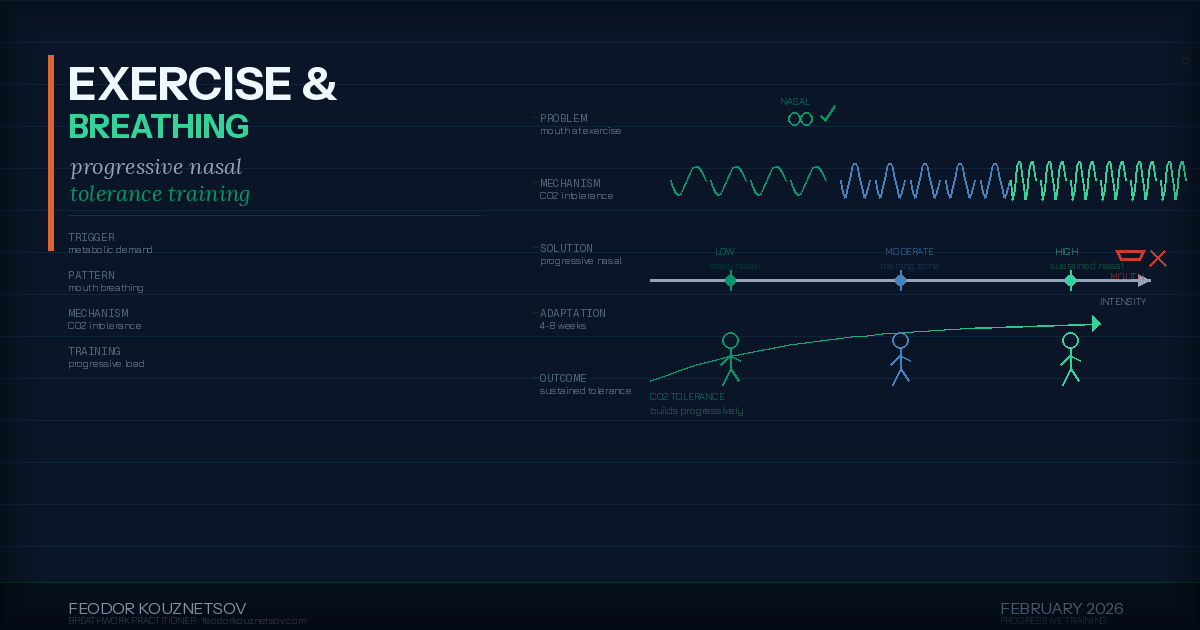
You cannot force nasal breathing at maximum intensity if you have been mouth breathing for years. The CO2 tolerance is not there. The retraining process must be progressive, starting at low intensity and gradually increasing load while maintaining nasal breathing.
Phase 1: Establish Baseline (Weeks 1-2)
Goal: Maintain nasal breathing during low-intensity activity
Protocol:
- Walk at a comfortable pace (conversational intensity)
- Breathe only through the nose — mouth closed, relaxed jaw
- If air hunger becomes overwhelming, slow down until nasal breathing is comfortable again
- Duration: 20-30 minutes daily
- Intensity: You should be able to speak in full sentences while nasal breathing
Do not progress until this feels easy. Most people need 1-2 weeks at this intensity before they can increase load without immediately reverting to mouth breathing.
Phase 2: Increase Intensity with Brief Intervals (Weeks 3-4)
Goal: Maintain nasal breathing during moderate-intensity intervals
Protocol:
- Walk or jog at a pace where nasal breathing feels challenging but sustainable
- Interval structure: 2 minutes at moderate intensity (nasal only) → 2 minutes at low intensity (recovery)
- Repeat for 20-30 minutes
- If you cannot maintain nasal breathing during the work interval, reduce intensity until you can
The air hunger will be intense initially. This is the recalibration process. You are training the chemoreceptors to tolerate the CO2 rise that occurs during exertion. It takes 2-4 weeks of consistent practice for this tolerance to develop.
Phase 3: Sustained Moderate Intensity (Weeks 5-8)
Goal: Maintain nasal breathing for extended periods at moderate intensity
Protocol:
- Continuous activity at moderate intensity (running, cycling, swimming) with nasal breathing only
- Duration: 30-45 minutes
- Intensity: You should feel challenged but not panicked — air hunger is present but manageable
- If you must mouth breathe, slow down until nasal breathing is restored, then gradually increase pace again
By week 8, most people can sustain nasal breathing at intensities that would have been impossible in week 1. The CO2 tolerance has adapted, and the breathing pattern has shifted.
Phase 4: High-Intensity Work (Week 9+)
Goal: Maintain nasal breathing at near-maximal intensities
Protocol:
- High-intensity intervals with nasal breathing: 30-60 seconds hard effort → 2-3 minutes recovery
- Nasal breathing maintained throughout both work and recovery intervals
- If nasal breathing cannot be maintained, the intensity is too high — reduce load
At true maximal intensity (sprinting, heavy lifting, competition), mouth breathing may be necessary for performance. But for 90% of exercise — daily activity, aerobic training, strength training at moderate loads — nasal breathing should be maintained throughout.
When Mouth Breathing Is Appropriate
There are situations where mouth breathing during exercise is appropriate:
- Maximal effort (>90% VO2max): True sprinting or maximal lifts where performance is the goal and nasal breathing limits output
- Emergency situations: Running from danger, acute physical threat
- During structured breathwork sessions that use hyperventilation: Circular breathing or other practices that intentionally use mouth breathing for specific effects
But these situations are rare. Most exercise — walking, jogging, cycling, swimming, strength training, yoga, recreational sports — occurs at submaximal intensities where nasal breathing is both possible and superior to mouth breathing.
The guideline: if you can maintain nasal breathing at a given intensity, you should. If nasal breathing is impossible even after progressive training, the intensity is too high for your current fitness level or you have structural nasal obstruction that needs medical attention.
Exercise as Breathwork Training
Retraining breathing patterns during exercise is not just about performance. It is the fastest way to correct chronic breathing pattern dysfunction because it addresses the pattern under the conditions where it matters most — during metabolic demand and sympathetic activation.
People who practice Buteyko breathing or coherent breathing at rest but continue to mouth breathe during exercise often fail to see lasting improvement because the dysfunctional pattern is still being reinforced daily. But people who retrain breathing during exercise see rapid improvements in baseline CO2 tolerance, resting breathing rate, and autonomic function because they are correcting the pattern where it is most ingrained.
Exercise becomes breathwork training. Every walk, every workout, every physical task becomes an opportunity to reinforce proper breathing patterns rather than perpetuating dysfunction.
When Individual Guidance Helps
For people managing chronic conditions (asthma, COPD, chronic fatigue, autoimmune disease, anxiety disorders) or recovering from injury, retraining breathing during exercise requires careful progression and monitoring. The assessment identifies baseline CO2 tolerance, exercise capacity, and specific breathing pattern dysfunctions. And in individual sessions, I guide the retraining process with appropriate intensity progressions and troubleshooting when the standard protocol does not work.
Nasal breathing during exercise is not optional if you want to correct breathing pattern dysfunction permanently. It is the training ground where the pattern either shifts or stays broken. Most people avoid it because it is uncomfortable. But discomfort is not danger — it is adaptation. And adaptation is what produces lasting change.
Next step
Want to work through your situation personally?
Disclaimer: personal experience & self-regulation practices. Not medical advice.