Ankylosing Spondylitis and Sleep — Night Pain, Morning Stiffness, and the Nocturnal Autonomic Shift
Why Ankylosing Spondylitis Pain Peaks at Night
Inflammatory back pain has a signature that separates it from mechanical back pain: it is worse at rest, worse in the second half of the night, and accompanied by morning stiffness that lasts longer than thirty minutes. People with ankylosing spondylitis (AS) often describe waking at three or four in the morning with deep aching in the lower spine, then moving stiffly for the first part of the day until activity loosens them. This pattern is diagnostic, and it is driven by physiology that runs on a clock.
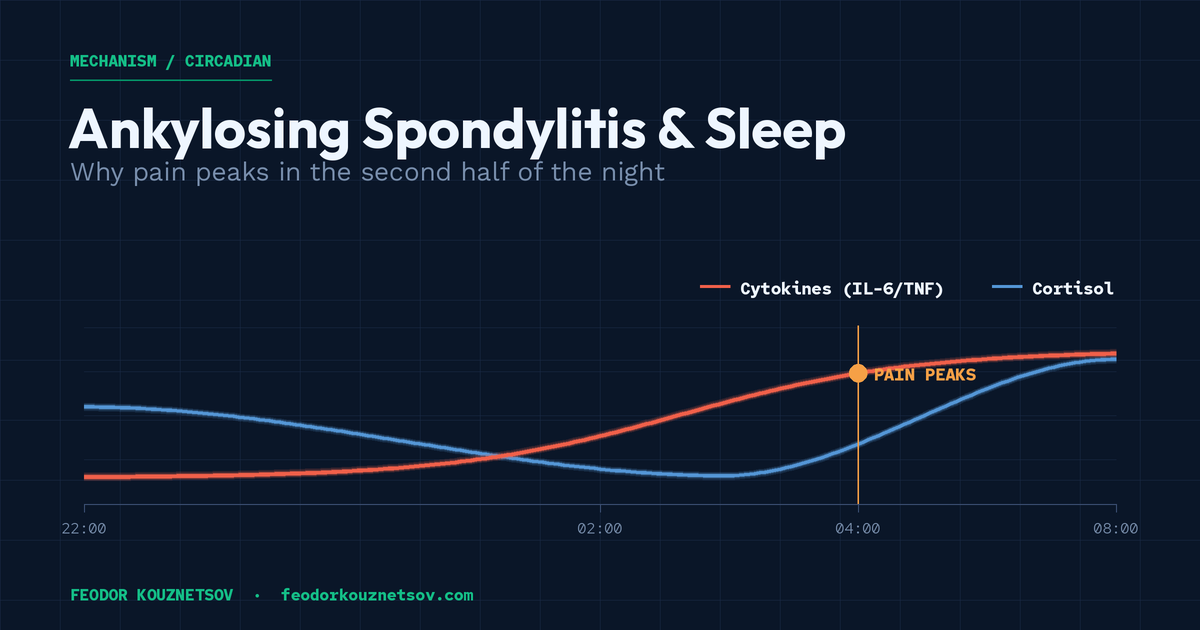
The main driver is the circadian rhythm of pro-inflammatory cytokines. Interleukin-6 (IL-6) and tumour necrosis factor (TNF), the signalling molecules central to AS inflammation, are not released evenly across twenty-four hours. Their levels rise through the night and peak in the early morning hours. At the same time, cortisol — the body's most powerful endogenous anti-inflammatory — reaches its lowest point in the pre-dawn window before rising sharply around waking. So in the second half of the night you have peak inflammatory signalling and minimum anti-inflammatory restraint arriving together. That is the biochemical reason the pain wakes you.
Immobility adds a mechanical layer. During long periods of stillness, the inflamed sacroiliac and spinal joints lose the low-grade movement that normally helps clear inflammatory fluid and maintain range. Stiffness is partly the accumulation of that stagnation, which is why the stiffness eases once you start moving. I described the broader inflammatory feedback loop in the AS breathing protocol post; sleep is where that loop is either interrupted or reinforced each night.
What Happens to Breathing When You Lie Down
Lying down changes respiratory mechanics in everyone, but in AS the change compounds an existing restriction. When you move from upright to supine, the abdominal contents push the diaphragm upward and functional residual capacity — the volume of air left in the lungs at the end of a normal exhale — drops. Breathing becomes shallower and more dependent on the rib cage at exactly the moment the rib cage is least able to help.
AS fuses the costovertebral joints where the ribs meet the spine. Thoracic expansion is already reduced during the day; at night, with the diaphragm splinted upward and the chest wall rigid, ventilation becomes shallower still. The result is a tendency toward mild nocturnal hypoventilation and a breathing pattern that is fast, shallow, and thoracic rather than slow, diaphragmatic, and nasal. If the mouth falls open during sleep, the problem deepens: mouth breathing bypasses the resistance and humidification of the nose, dries the airway, and reliably fragments sleep. I covered that cascade in detail in the post on how mouth breathing affects sleep and stress.
The Nocturnal Autonomic Shift
Sleep is not a uniform state. In non-REM sleep, parasympathetic (vagal) tone rises, heart rate slows, and heart rate variability increases — this is the body's nightly parasympathetic recovery window, the period when inflammatory tone is most effectively down-regulated. In REM sleep and in the early morning hours, sympathetic activity surges again. A healthy night lets the deep parasympathetic phases do their anti-inflammatory work.
Disordered breathing sabotages exactly this. Shallow thoracic breathing and mouth breathing keep sympathetic tone elevated and repeatedly nudge you toward lighter sleep or micro-arousals. Each arousal blunts the vagal recovery that would otherwise counterbalance the early-morning cytokine peak. The nervous system never fully hands over to the parasympathetic branch, so the one window in which inflammation could be actively suppressed is spent in partial sympathetic activation. The relationship between breathing rhythm, autonomic state, and circadian timing is the subject of the chronobiology post.
Why This Becomes a Loop
The pieces reinforce each other. Night pain and stiffness fragment sleep. Fragmented sleep reduces parasympathetic recovery. Reduced parasympathetic recovery leaves the early-morning cytokine surge unopposed. Higher inflammatory signalling produces more pain and stiffness the next night. Add shallow, restricted breathing and the sympathetic tone that comes with it, and the loop tightens. This is the same self-reinforcing dynamic that runs through AS during the day — described in the post on chronic holding patterns — but at night the leverage is unusually high, because sleep is when the parasympathetic branch has its clearest opportunity to act.
Protocol: Preparing the Nervous System for the Night
The aim is not to force sleep. It is to shift autonomic state toward parasympathetic dominance before sleep, keep breathing nasal and diaphragmatic through the night, and use position to reduce the mechanical load on the spine. I have used versions of this for years managing AS, diagnosed in 2012 and held without constant medication since 2015.
Pre-sleep: extended-exhale nasal breathing
- Ten minutes of slow nasal breathing before sleep, exhale longer than inhale — roughly four seconds in, six to eight seconds out.
- Keep it light and diaphragmatic, not deep. The goal is rhythm, not volume.
- Expect the heart rate to settle and the body to feel heavier as you continue.
Mechanism: a prolonged exhale engages the baroreflex and raises vagal tone, moving the autonomic balance toward the parasympathetic side before you try to sleep. This is the same rhythm covered in the coherent breathing post, biased toward a longer exhale.
Through the night: keep breathing nasal
Nasal breathing during sleep is the single highest-leverage change. It preserves airway humidification, maintains healthier CO2 levels, and keeps sympathetic tone lower than mouth breathing does. If you know or suspect your mouth falls open at night, treat that as a priority to correct — the reasoning and the correction steps are in the mouth breathing post.
Position: reduce spinal flexion load
AS tends to pull the spine toward flexion. Sleeping curled on your side with a high pillow reinforces that direction over years. A flatter pillow that keeps the neck closer to neutral, and short periods lying prone or flat on the back to encourage extension, work against the fusion tendency. The point is not a single perfect position but avoiding sustained flexion through the night.
Morning: move before you judge the day
Morning stiffness is at its worst in the first minutes after waking, when cytokines are still high and cortisol is only beginning to rise. Before getting up, a few minutes of slow diaphragmatic nasal breathing and gentle spinal movement in bed begins the autonomic shift toward daytime state and starts clearing the overnight stagnation. Stiffness that feels alarming on waking usually eases substantially within the first hour of movement and breathing — expecting that curve makes the morning less discouraging.
When Individual Guidance Helps
For people whose AS strongly disrupts sleep, or who are unsure whether they are breathing through the nose at night, individual work helps establish the protocol correctly and identify what is actually happening overnight. The assessment looks at baseline breathing pattern, CO2 tolerance, and sleep disruption. In individual sessions I guide the pre-sleep and morning routines to your specific presentation. This is not quick relief — it is a nightly shift that compounds over months, in the same way the daytime protocol does.
Next step
Want to work through your situation personally?
Disclaimer: personal experience & self-regulation practices. Not medical advice.